Everybody Came
Bats distributed: twelve. Bats counted out onto the pavement, one at a time, by an officer of the United States government: forty-seven.
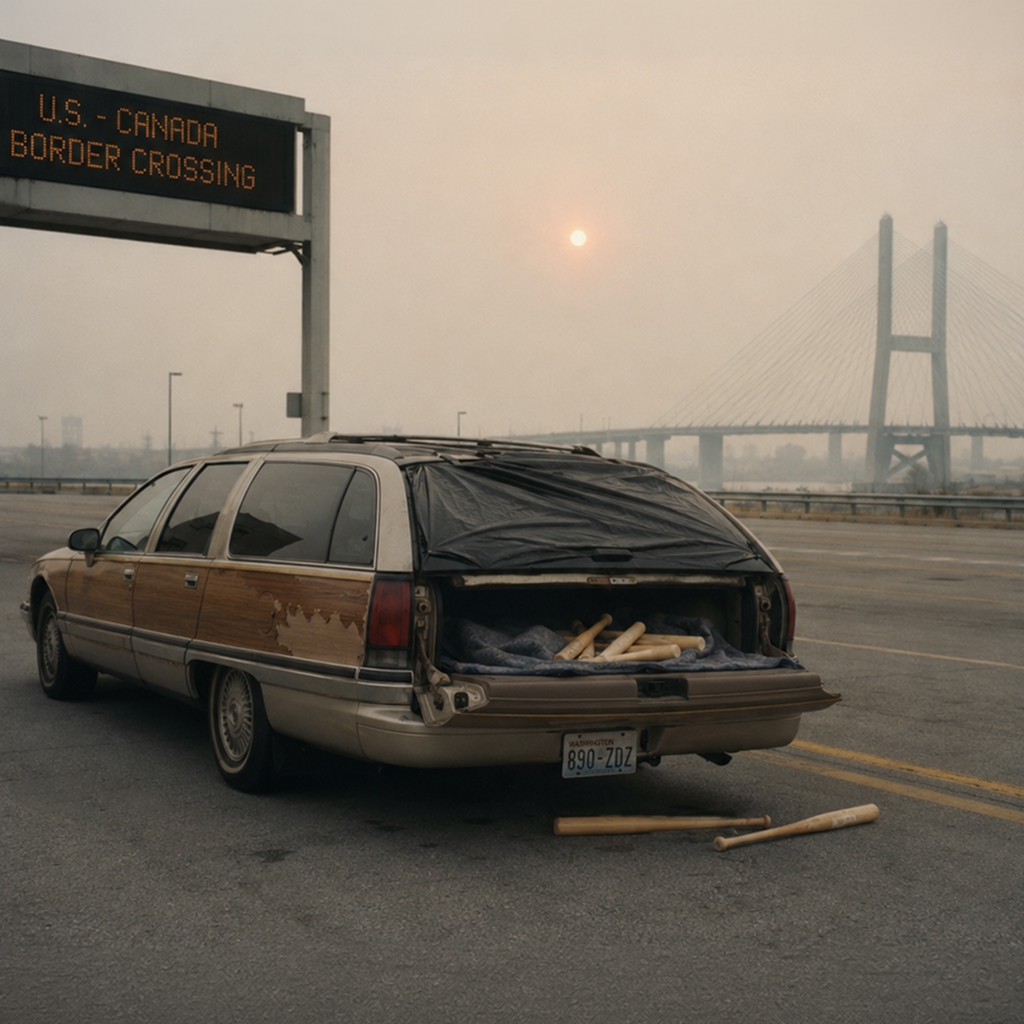
We came down out of Ontario on Thursday with a garbage bag taped over the back window, and the United States of America took one look at us and asked us to pull over to the right.
You cross at Windsor on the Ambassador Bridge, which is a blue suspension bridge from 1929 that a private family owns like it's a hardware store. Downriver from it the new bridge stands finished — towers up, deck across, cables strung, and not one car on it. They'd said June. Then they said July twenty-seventh. A man in the line ahead of us said August, and the woman at the coffee place on Huron Church said nobody's telling anybody anything, and I've decided both of them are right. It is the only bridge I have ever seen that looks embarrassed.
The radio was all smoke — the fires up north, the air, the president saying the cost of the pollution ought to go onto the tariffs, and something about a call with the prime minister. Every station on both sides had it, and the Roadmaster gets AM and nothing else, so we heard it four times before the booth.
Going into Canada on Monday, nobody opened the back. Coming home they opened all of it.
I want to be fair about this. The officers were not rude and they were not unreasonable. A 1991 station wagon with Washington plates, two older men, a garbage bag flapping where the rear glass should be, and behind the bag, stacked to the headliner in wool blankets, forty-six identical lengths of turned fir and one that isn't wood at all. If I saw us I'd search us. They had us out on the concrete in the hazy sunlight and they took the blankets off and laid the bats down in rows on the pavement, and a young officer walked the rows with a clipboard and counted them, and then counted them again.
Are you selling these? Not lately. Are these for sale? Not these, really. Then what are they? Samples. Samples of what? Wood. It went like that for a while. Somebody wanted the value of the load, and it turned out that between us — a man who has been in professional baseball since 1976 and a man who has been writing sentences for a living since the nineties — neither of us could say what forty-six baseball bats are worth. The only money anybody has ever paid us for them came out of a club in the Bronx in June, for six. I did that division on the pavement and multiplied it back up and said the number out loud and it sounded like a lie. It was the truth. He wrote it down.
Then he got to the aluminum one and stopped, because it doesn't match, and because nothing about it matches.
"That one's not ours," Cecil said.
"Whose is it?"
"Fella in Toronto."
The officer waited for the rest of it.
"He left it," Cecil said.
That was the whole of Cecil's testimony and it is more than I have gotten out of him about that bat since it came into our lives. The officer wrote aluminum, 1 on his sheet, put a zero in the value column that I thought generous, and moved on.
Ninety minutes. Then the blankets back on, the bag re-taped, the tailgate slammed twice the way it has needed slamming since the Rockies. While we were loading, the smoke was coming across the river from the Canadian side in a long low band, as it had all week.
"Smoke got through," Cecil said.
We got in and drove into Detroit and missed the ballgame entirely. I had coneys at eleven at night at one of the two places downtown that share a wall and have spent a century arguing over which one is the original. Two brothers started them. Cecil had the Greek salad. I picked one on purpose so I'd have a reason to go to the other one later, which I never did.
Friday morning we got the glass fixed, because you do not drive a broken car around the Motor City of all places.
The place was on the east side, a bay and an office and a coffee maker, and the man had rear glass for a 1991 B-body wagon on a rack out back, which I did not expect and which he found funny that I did not expect. He knew the car before he'd finished walking around it — built at Willow Run, he said, out in Ypsilanti, thirty-some miles west of where we were standing, and GM shut that plant a year or two later and took the work down to Texas. He had the glass out and in and cleaned in under an hour.
He walked around to the front on his way to the register and put a finger near the star in the windshield — the one a lumber truck threw up outside Knockwood in April, on Cecil's side, that grew an inch of itself in the Wyoming cold — and said he could do the whole windshield today, no waiting, and quoted a price.
"No," Cecil said. "It's holding."
Two hundred and eighty-five dollars, company card, out by eleven.
We had a meeting at three. Cecil set it up out of Toronto — a man he knows in the Line's clubhouse, one of his, thirty-some years of the same minor league ballparks — and I had the two-minute version of the pitch running in my head the whole way over. Fir. Volcanic soil. Forty-six years of new growth. Feel where the weight wants to sit.
We parked in a garage on Montcalm. I want the home office to know I am aware what follows is not a sales report. There was a pigeon up in the beams somewhere on the fourth level, and the sound a pigeon makes inside a concrete parking garage is not the sound it makes outside. It comes back at you off six surfaces a half-second late, so the bird is having a conversation with a version of itself that is slightly behind. I stood there with the bag on my shoulder longer than I needed to.
They walked us back under the stands to a room off the tunnel with a whiteboard on one wall and a television going with the sound off, and the room was full.
It was Denny's last day.
Denny is — was — the clubhouse man. Forty-one years. He started as a kid at the old park at Michigan and Trumbull in 1985 and he is going out of this one, and Friday afternoon between the tarp and batting practice they gave him a sheet cake from a grocery store, white with blue frosting, with a bat and a ball piped onto it in a way that made the bat look like a chicken leg. There were paper plates. There was a coffee urn nobody had plugged in. There was a folding table with a plastic cloth taped to the underside of it, and a framed jersey in a box with the number 41 on the back, which somebody explained twice, both times to me.
Cecil's man got to us in the first minute and was glad to see him, both hands wrapping his. Then he looked around the room and said give me twenty minutes and went to be somewhere else. I set the bag down against the wall by the door and that is where it stayed.
Here is what I did not expect about Denny. He is thrilled. Not brave about it, not making the best of it — thrilled. He and his wife have a place up on a lake past West Branch and a pontoon boat that he described to four separate people at four separate levels of detail. He had a picture of the lake on his phone that went around the room. Cecil looked at it when it reached him and passed it on. When a young guy asked him what he'd miss he thought about it for a second and said, "Not the socks." He said forty-one years of other men's socks. He said it twice and it got a laugh both times, and the second laugh was bigger.
Through the wall you could hear batting practice going. The whole party, the entire time, that sound — the cage rolling, the flat crack of it, a coach's voice you couldn't make out any words of. Nobody in the room turned toward it. It was three o'clock on a Friday and there was a ballgame at 6:40 and the building was doing what it does.
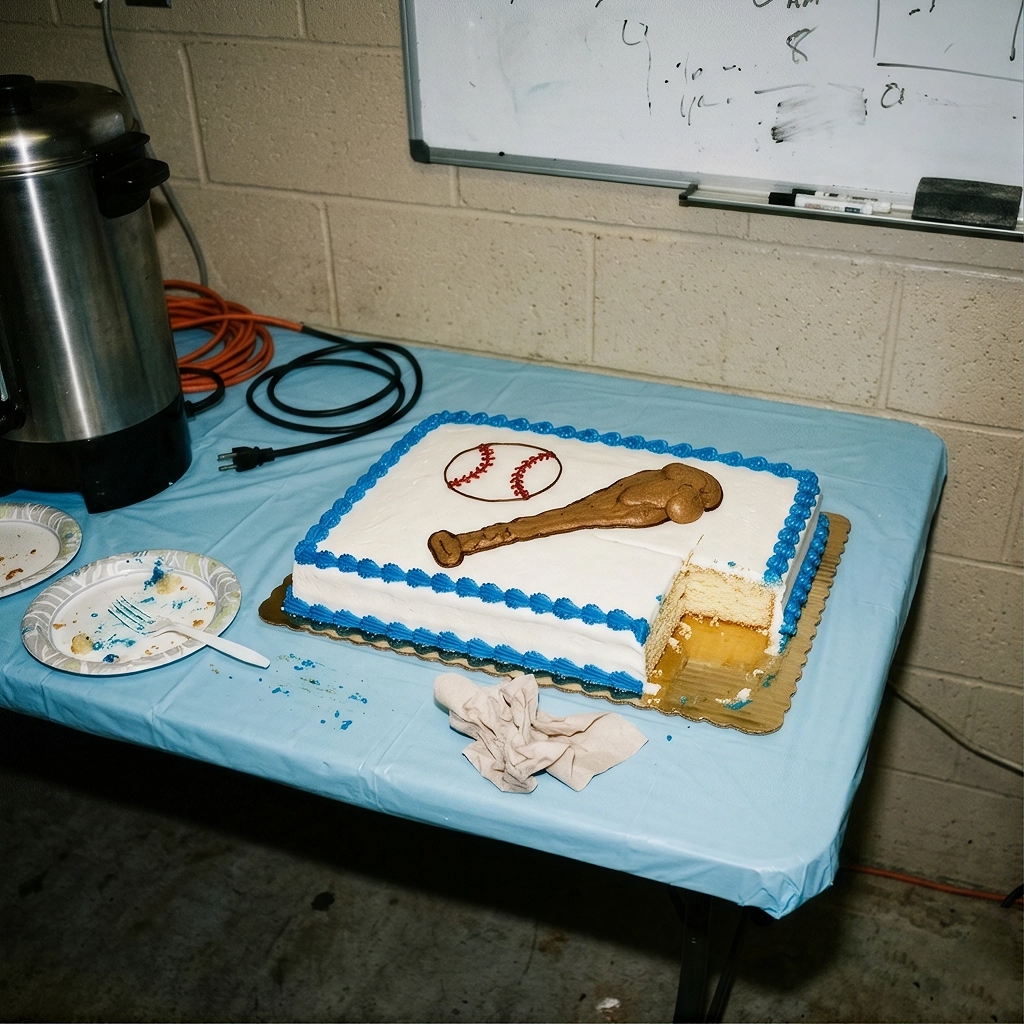
They made him stand by the whiteboard and two colleagues gave speeches. The first was short and the second was not. Somebody's phone went off in the middle of the second one and did not get silenced. Then they gave him the jersey in the box and made him hold it up, and he held it at an angle where nobody could read it, and someone said turn it, Denny, and he turned it the wrong way.
I had my pad out of my jacket before I knew my hand had gone in after it, my other hand clicking the ballpoint pen open. I put them away.
Then Denny said a few words. They were his.
The cake got cut by a woman in a club polo who had clearly cut a lot of cakes in that building, and the line went along the folding table, and I got in it. It was a grocery store sheet cake. I have eaten in some very good rooms on this trip on a company card, and a sheet cake in a windowless room under a ballpark is not worse than any of them. It is only different. There is a particular thing about the frosting they use that I could taste for an hour afterward.
Standing at the end of the table with a plate, a guy of about thirty-five with a lanyard looked at me and then at Cecil and back at me.
"You're the guy that's been writing about Mr. Tate."
There is no version of this where I say the next thing well, so I did not say anything, and I did not have to.
"He plays it up," Cecil said, and reached past him for a fork.
The guy laughed. The line moved. Somebody wanted to know if there was more cake in the box.
A minute later a woman handed me the lid off the cake box and said hold that a second, and went to deal with the urn, and did not come back for it.
Then the room got Cecil. One old-timer came over about somebody they'd both known in Toledo, and then that was two, and then it was four of them backed into the corner by the whiteboard with their plates going cold, and Cecil in the middle of it with his cap pushed back. He was over there fifteen minutes. Maybe twenty. I stood by the folding table holding the lid off a cake box, and a laundry cart came through and I got out of its way, and it came back through and I got out of its way again, and a man I never got the name of asked me if I was with the club and I said no.
It was a good party. Nobody was anything but kind to me, and nothing in it happened to me at all.
We stayed until the cake was gone. Then the room went down to the field at a quarter to five, all at once and without anybody saying so, and Cecil's man found us on the way out with his hand out and said he'd call. Denny shook Cecil's hand and told him to look him up if we ever got up past West Branch. Denny shook my hand too, and they took him down with them. I carried the bag back out through the tunnel and up the ramp with the zipper still done up, the way I'd carried it in.
The Line had the Fountains in for four. Friday night the place filled early because there was a concert after — Flo Rida, which I pronounced like the state until Cecil told me it was Flow Rider — and I have never seen forty thousand people sit so cheerfully through nine innings they had no stake in on their way to something else.
The Line scored both their runs in the first inning and never needed another. Cecil made us stay to the last out anyway.
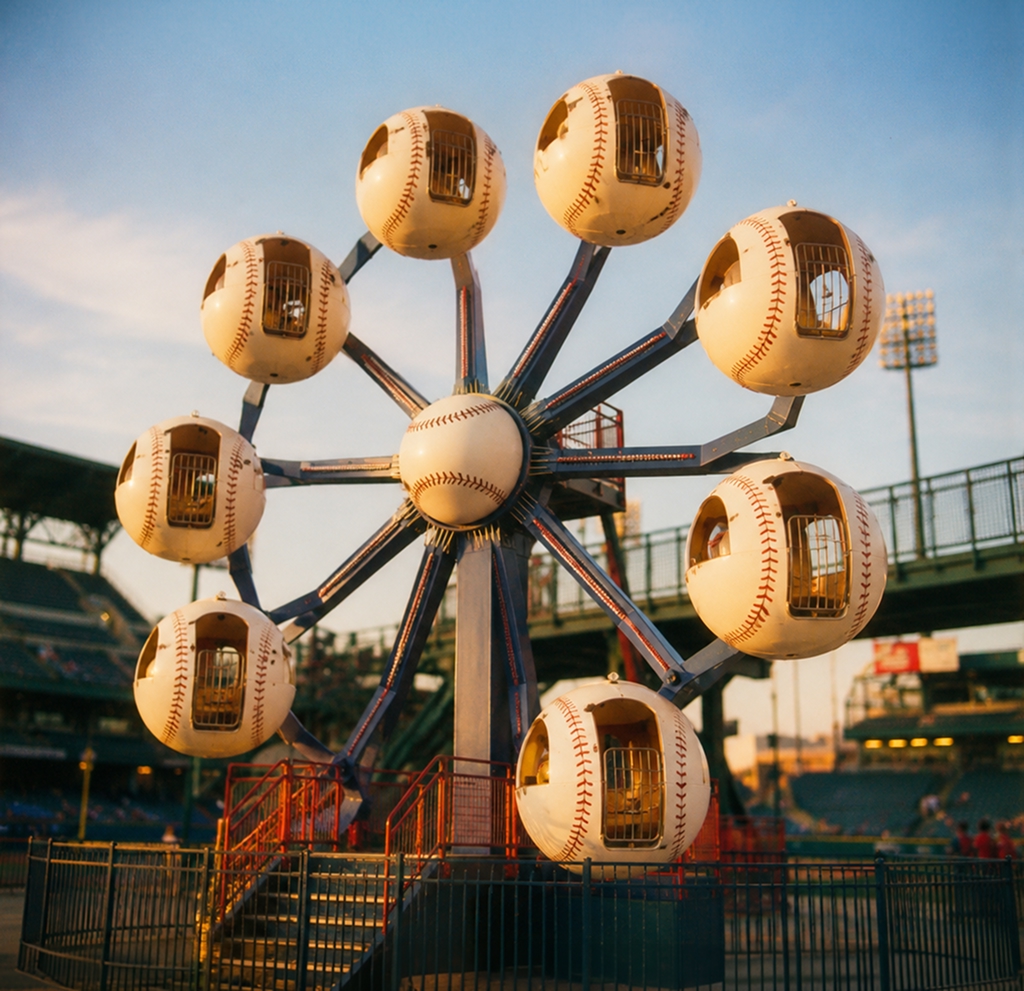
Comerica Park has a Ferris wheel in it whose cars are baseballs. It is the friendliest ballpark I have been in. They built it a mile and a half up the road from where the last one was.
Sunday evening we came out of the lot behind the last of the traffic and got on 75 south with forty-seven bats in the back and the count still at twelve, Pittsburgh four hours down the road.
The new glass is clean and dark and seated tight, and the wagon is quiet at speed for the first time since Canada — quiet enough that I could hear Cecil breathing in the seat beside me, which is a thing you can hear in a car when there's glass in all the windows.
— Freely
Fantasy baseball without the homework.
Want in for the 2027 season? Leave your address and we’ll send one note when leagues open in March.