Higher
Bats distributed: twelve. Days to the deadline: five. Days to the other deadline: three.
We came into Pittsburgh Sunday night through a hole in a mountain.
You come down off the hills on the parkway in the dark with nothing whatever to look at, and the road goes into Mount Washington and stays in there for most of a mile — tile and orange light and the sound of your own car coming back at you — and then it lets you out onto a bridge and the whole city is standing there at once. Three rivers. The point where they meet. A wedge of downtown lit floor by floor. I counted six bridges before we were across and there were more out of view. Cecil has come in this way before and did not look up from the road atlas.
I would drive back out and come in again if it were free.
The phone went off in the cupholder while we were still on the bridge, and again before we were across it. My ex-wife. I didn't get to either one until we'd stopped.
You never answered about the tuition.
Asher asked me what you said.
She is right that I didn't. The first one came in Boston, the Friday of the doubleheader — a long one, with reasons in it, and my half broken out to the dollar so there would be nothing to discuss. I have read that message a good many times. I have never written back.
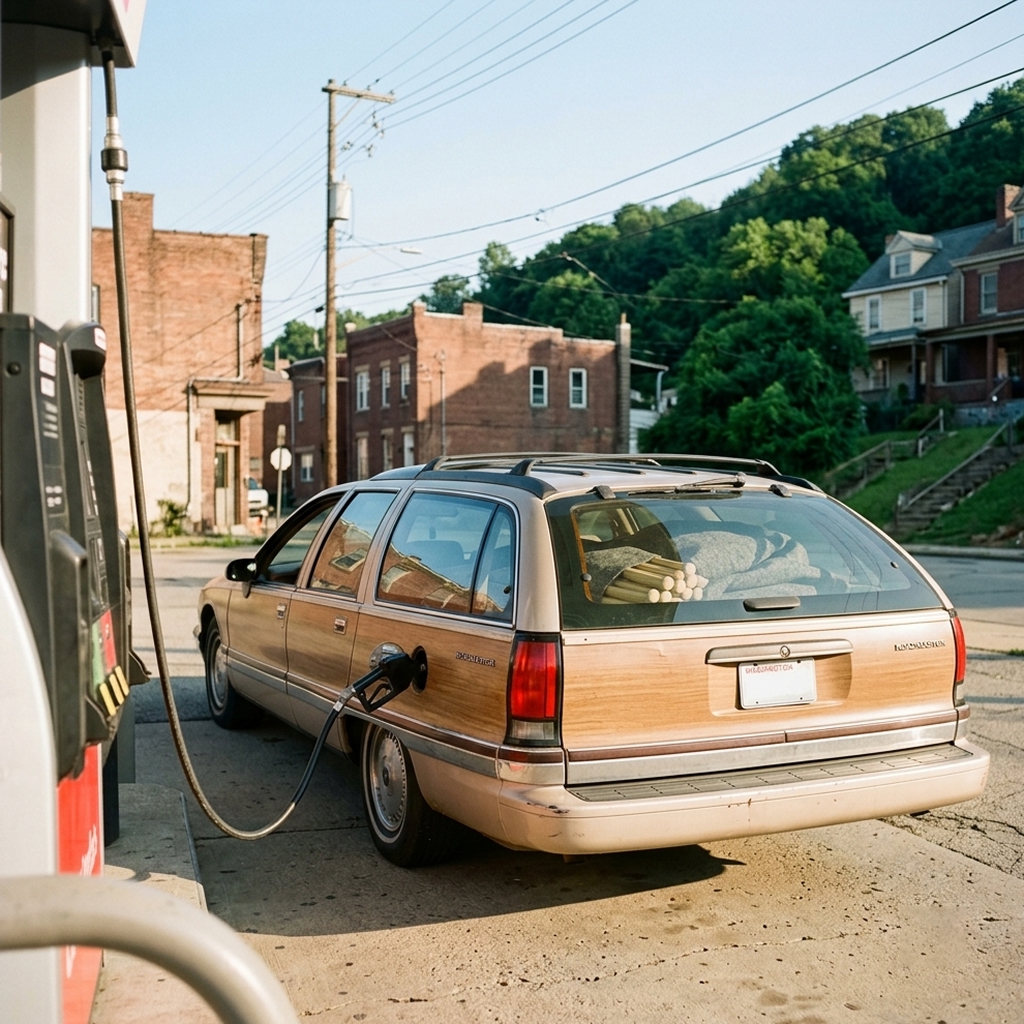
Monday morning we filled the tank on the North Side. Four thirty-nine a gallon on the board, and I'd let it run down past where the needle tells the truth, so it took all twenty-two gallons and stopped at ninety-six dollars and fifty-eight cents.
"Three and a quarter back in Phoenix," Cecil said, leaning over from the passenger seat.
Four months of AM radio has mostly meant hymns and polka. This week it was an education. The Pittsburgh Whiskey Rebellion are fifty-four and fifty-two and a game out of the last wild card, the trade deadline is the third of August, and this town has not been able to put those three facts in one sentence in close to ten years. So the radio was wall-to-wall arithmetic. Somebody had worked out to the dollar what the club could add and still stay under what it says it can spend, and he read the number twice so people could write it down. There is a rotation here everyone agrees is the good part and a bullpen everyone agrees is the problem, and by Tuesday I could have taken calls myself. Cecil let it run. The one thing he said about any of it was that nobody in those buildings goes home till the third.
The club is named after a tax revolt — 1794, farmers out here, whiskey, a federal excise on the only thing they made. I read that off my phone at a light on East Carson and then the light changed.
The visiting club was the Arizona Copper Works, which put us in a building with the first team we ever watched together — a Tuesday in March at Chase Field, Coppers and Cuyahoga, a spring game that counted for nothing. They're in Cleveland against that same opponent on Friday. So are we.
Tuesday morning over motel coffee I asked him the thing I ask in every town — whether he knew anybody in that building. He said he did. Then he said we weren't going to call him. Not this week.
I pushed.
Whoever put us in Pittsburgh the week before the deadline had not asked Cecil about it. Call him in November, he said, when the man has nothing to do but answer his phone. Then he went back to the paper.
I said we'd driven past Cleveland to get here and would be driving back to it Friday, which was true and was not a reason. I said the deadline was the whole reason, everybody's in the building this week. I said we had never once been in a town where he had a man and not gone. It wasn't an argument. It was a man asking for something and dressing it up as a plan. I did not tell him why I needed something to happen this week.
He looked at me a long second. Then his eyebrows went up, and he got out his phone and started scrolling back through it, and kept going back, because the number was nowhere near the top and he hasn't needed it in years. He found it in an old list of some kind, wrote it on the motel pad, and dialed off the pad, which I have never seen anybody do.
I only got his half of it.
"Cecil Tate." Then a stretch of listening. He set his free hand flat on the table and left it there. "No, no. I'm in town." More listening, longer. He turned partway toward the window and looked out of it and did not see anything out of it. "I know what week it is." A while. "Ten minutes is all it is." Then: "I'd take that."
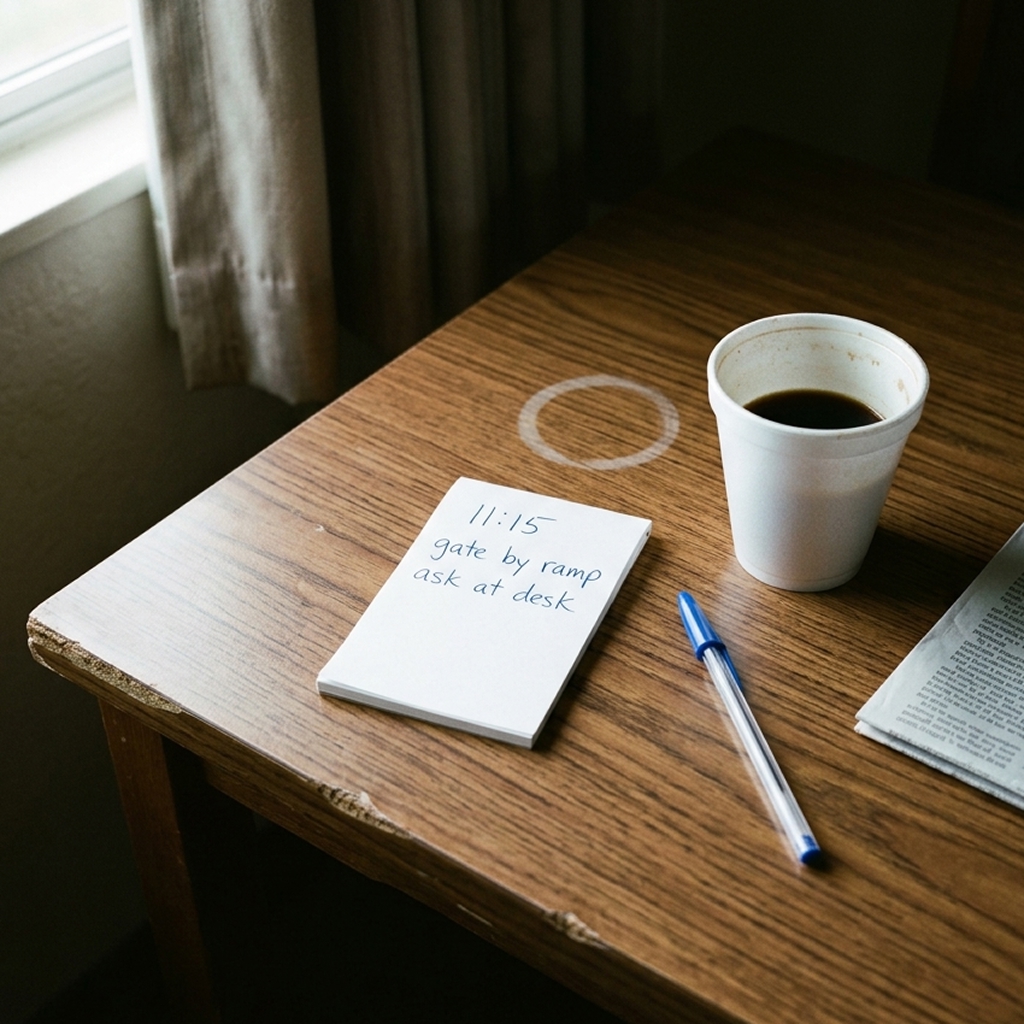
He wrote on the pad again and hung up and told me eleven-fifteen, gate by the ramp, ask at the desk.
Four minutes.
I know it was four minutes because there was a clock over the bulletin board and I looked at it when we came in and again when he left. He met us there, in a corridor of painted block — big man in his fifties, club polo, glasses up on his head — and he said Cecil's name before we'd got all the way down to him.
"Wendell still running that camp?"
"Wendell sells boats."
"Course he does."
They both laughed, and I laughed about a second and a half behind them.
Then he said alright, what've you got, and I had two minutes and I used them.
I'll tell the home office this much: I did not lead with the mountain. I led with the feel — where the weight wants to sit in a batter's hands — which is Cecil's line, and I have watched it work on four men in four cities, and I finally had the sense to steal it. The soil came second and got one sentence, and I did not say volcanic like it was a card I'd been holding.
He let me finish. Then he asked one question and it was a real one: how much the density moves billet to billet, coming as it does off one slope of one mountain. I knew the answer, because I have been in a car with a man since March and I listen. I told him it moves less than he'd expect and more than we'd like, that there are two labs working on getting exactly that answer, and that I'd send him what came back the day it came back.
He nodded. It was a decent answer and he took it like one.
Then he said no.
He said it kindly and he said it fast. Not this year. Nobody in the building is thinking about anything but the third of August, and after that nobody thinks about wood until it's cold. Come see him in the winter. The bag I was carrying never got opened. He put a hand on Cecil's shoulder going past, told him to take care of himself, and was gone up the corridor to his eleven-thirty.
Out in the lot Cecil said, "That's a real answer."
I wrote a sentence in Toronto last week about how a no is at least a thing that happened. I meant it when I wrote it. Standing in that parking lot I did not.
Nothing came out of the wagon in Pittsburgh. Nothing has counted since the Bronx.
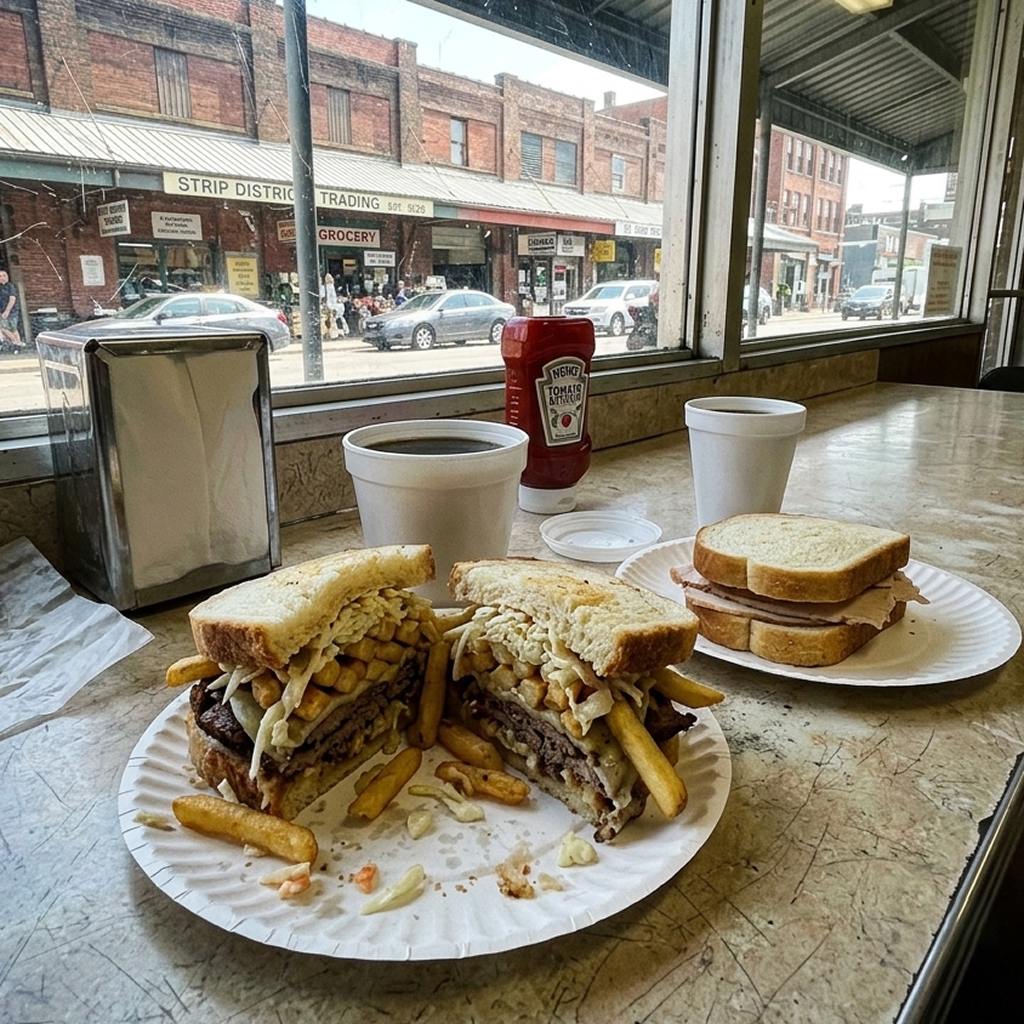
We ate in the Strip District, a half mile of old produce terminals and Polish counters and a fish market older than my father. The sandwich here puts the french fries and the coleslaw inside the bread with the meat. It sounds like a bit and it isn't one — it started as a thing you could eat with one hand standing next to a truck at four in the morning, it is still that, and it is fourteen dollars.
I ordered one. The counterman looked past me at Cecil, and I said, "He can't have it. He's on a heart thing."
Cecil stepped up beside me and ordered a turkey sandwich without the fries and the slaw, and a coffee, and paid for them himself out of a folded bill, and we carried it all to a table by the window.
He got halfway through his sandwich before he said anything.
"You could ask."
That was the whole of it. Later he looked over at what was left of mine and said the fries on the inside was a sound idea and he didn't know why nobody else had thought of it, and I said he wasn't wrong, and we ate.
Coming out I had sixteen dollars in my pocket I hadn't planned on having. Thirty out of the day's money for the two of us, fourteen spent. I put it where I put it. Cecil was holding the door. I'd thought he was already through it.
On the way to the wagon Cecil said he'd be a minute and went in through the doors of the hotel downtown where the Coppers are staying. He was gone a quarter of an hour. He came back and got in and said we ought to eat early Wednesday on account of the day game. I did not ask him where he'd been. I had my own arithmetic running and it has been running since Boston.
PNC Park is the best ballpark in America, and the reason has almost nothing to do with the ballpark. They built it small — two decks, thirty-eight thousand seats — and kept it down under the skyline, and what you look over is the Allegheny and a row of yellow bridges and the whole downtown standing up behind them. They didn't put anything out there. There was already something out there.
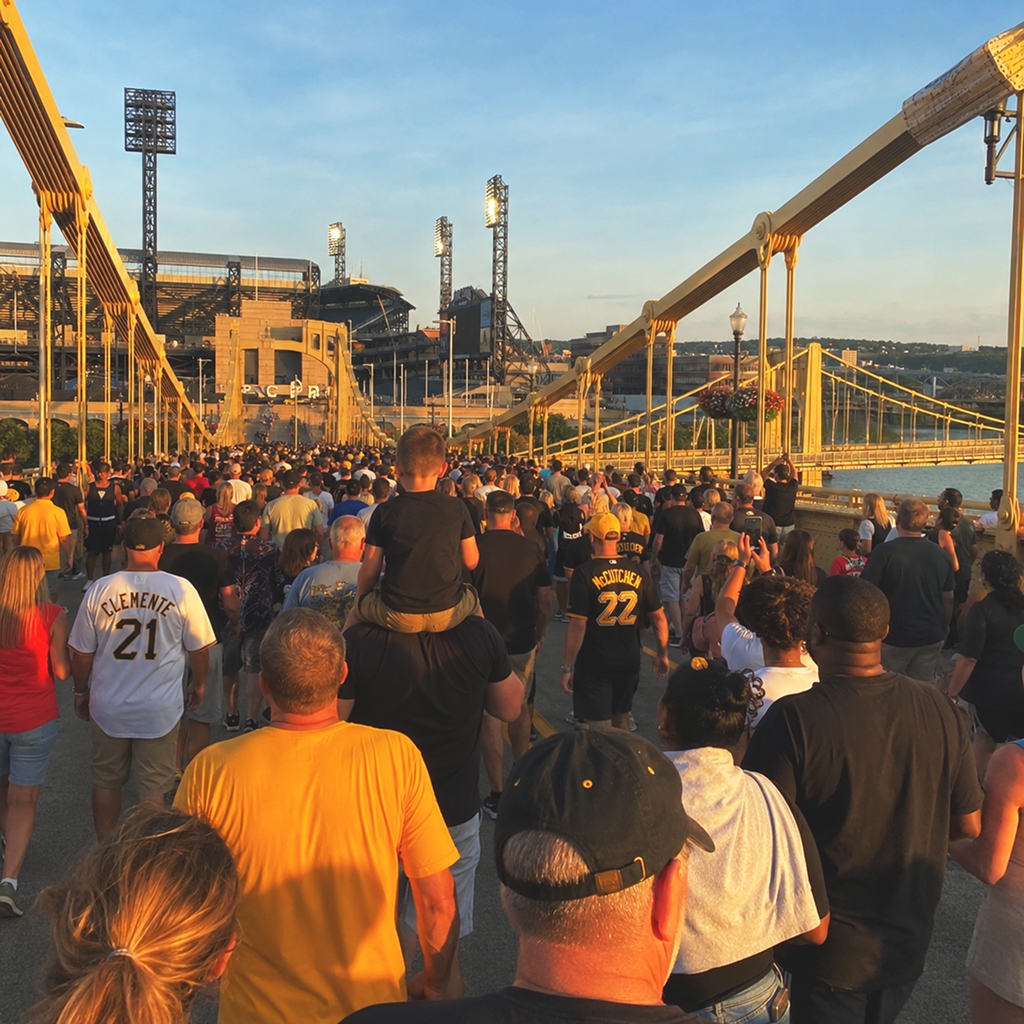
On game days they close the Roberto Clemente Bridge to cars and everyone walks over it. Six minutes on foot in a crowd with the water going by underneath and the park getting bigger, and it's free, and half this city does it and thinks nothing of it.
We sat in left field, twenty dollars, the cheapest seat on the lower level in that building — cheaper than the upper deck, which makes no sense until you're sitting in it. Tuesday was our second night in those seats.
The Coppers had five by the end of the fourth and none of it left the yard — a double into the corner, some singles, a run that came in on a ground ball. Pittsburgh took Bubba Chandler out after four and the park gave him a hand on the way off anyway. Brandon Pfaadt was throwing for Arizona and had given up nothing at all.
Behind us two men were doing the bullpen out loud — what a setup man costs, who in the low minors they could stand to lose. One of them had the same figure the caller on Monday had read out twice.
My phone buzzed in the fourth.
I need to know before Saturday.
I read it and put it back in my pocket and did not look at the field for a while.
Cecil said, without turning his head, "How much do you need."
I did not say anything. It is a number I have carried since Boston and I could not hand it to him.
"Couple thousand?"
"Higher," I said.
He pushed his cap back and pulled it down again. He watched the field. He didn't ask again.
This is the first season a hitter can argue. The umpire calls it, and if the man at the plate or the catcher or the pitcher thinks he's got it wrong he taps the top of his helmet right then, or his cap if he's pitching — it has to be him, nobody in the dugout is allowed to tell him to — and the park puts the pitch on the board and the call stands or it doesn't.
In the fifth Pfaadt threw one to Jake Mangum that the umpire called a ball, and Pfaadt tapped his cap before the catcher was out of his crouch. The board put the pitch up in its little box, catching the bottom edge of the zone. Strike one. The park booed the box.
Arizona added another in the sixth. Pittsburgh put up three in the eighth on a Ryan O'Hearn double and a string of singles, and it was 6-3 and everybody was standing.
In the ninth Arizona brought in Paul Sewald to close it out. But Mangum doubled. Then Brandon Lowe hit the next pitch he saw into the seats in right. Bryan Reynolds, up behind him, put one in almost the same place, and it was 6-6. Back to back.
Somebody two rows down stood up holding his phone over his head with both arms and did not look at it. Behind me the two who had been trading relievers all night were hugging.
In the tenth Cecil said the man they had out there was finished, two hitters before anybody else in the section thought so, and Arizona scored. So did Pittsburgh in the bottom half, and we went to the eleventh tied.
In the twelfth, with a runner on second and James McCann up for the Coppers — he had three hits already — Cecil said they had the right fielder in the wrong place. McCann hit it to right and it fell in front of him and the run came in and that was the ballgame. Coppers 8, Rebellion 7.
He was right both times and mentioned neither one.
Afterward we walked back over the bridge with everybody else. It took a long time to get across and nobody was in a hurry. They had been down six to nothing and come all the way back and lost it anyway, and I did not hear one person on that bridge who sounded sorry about it. A kid up ahead was asleep against his father and stayed asleep the whole way over.
In the motel lot I typed I'm working on it and sent it, which is the first thing I have sent her about any of it in twelve days.
She started typing back before I had the phone down. It went on a while. I stood there in the lot and watched it go on.
That's not an answer.
Then I went out to the wagon.
The folding money lives behind the visor and that is only the running-around money. I got it down and counted it on the passenger seat with the dome light on. Four hundred and forty. The wallet had a hundred and eighty-five, counting the ones. The envelope I'd carried out of the room with me — it rides in the bottom of my bag and it goes up the stairs with me every night, every town — came to two thousand three hundred fifteen. That is all of it.
I did the sum on the back of a gas receipt with a ballpoint pen. Two thousand nine hundred forty dollars. I didn't believe it, so I did it again from the top in a different order, and got two thousand nine hundred forty dollars.
Six thousand two hundred forty is what the letter said.
I wrote the subtraction under it. Thirty-three hundred.
It was half past midnight and the lot was empty and a truck was idling somewhere past the fence. I folded the receipt in half with the sums on the inside, put it in my shirt pocket, buttoned the pocket, and went in.
Wednesday's game started at twelve thirty-five, which is a civilized hour to play baseball and a hard hour to leave a town on.
The Coppers won 3-0 and took the series, and the only ball that left the yard all afternoon was Gabriel Moreno's, four hundred and seven feet to center.
Then we went back out of Pittsburgh the way we came in, up the parkway and into the mountain, tile and orange light, and when it let us out the other end there was nothing to look at but hills. Cecil slept some of it with his cap down over his eyes. Past the state line the radio came in out of Youngstown, still on the deadline, still on the arithmetic, and a caller was saying they could get it done if they were willing to spend.
— Freely
Fantasy baseball without the homework.
Wallop is a home run-only game for friends — simple enough to play all season without the daily grind. Start a league and draft any time before September.
Start a League