The Story
Bats distributed: twelve. Double what we had before we walked into the building, and the first a team ever paid for.
We came into the Bronx on Monday with the city dressed for the Fourth — flags off every other window, the harbor down at the foot of the island getting ready for the tall ships, the same fleet we'd watched off Baltimore, due in for the country's two hundred and fiftieth.
Voss had said he'd ask around. I'd filed it under the polite end of a polite no — the gentlest door I'd watched close on us in three months. But a Baltimore equipment man knows a Bronx one, and somewhere over the weekend a phone number traveled, and Monday afternoon a man from the New York Uniques called Cecil and asked us up to the Stadium the next day. Cecil set the phone face-down on his knee. "Voss came through," he said. He was pleased. He thought his work had done it.
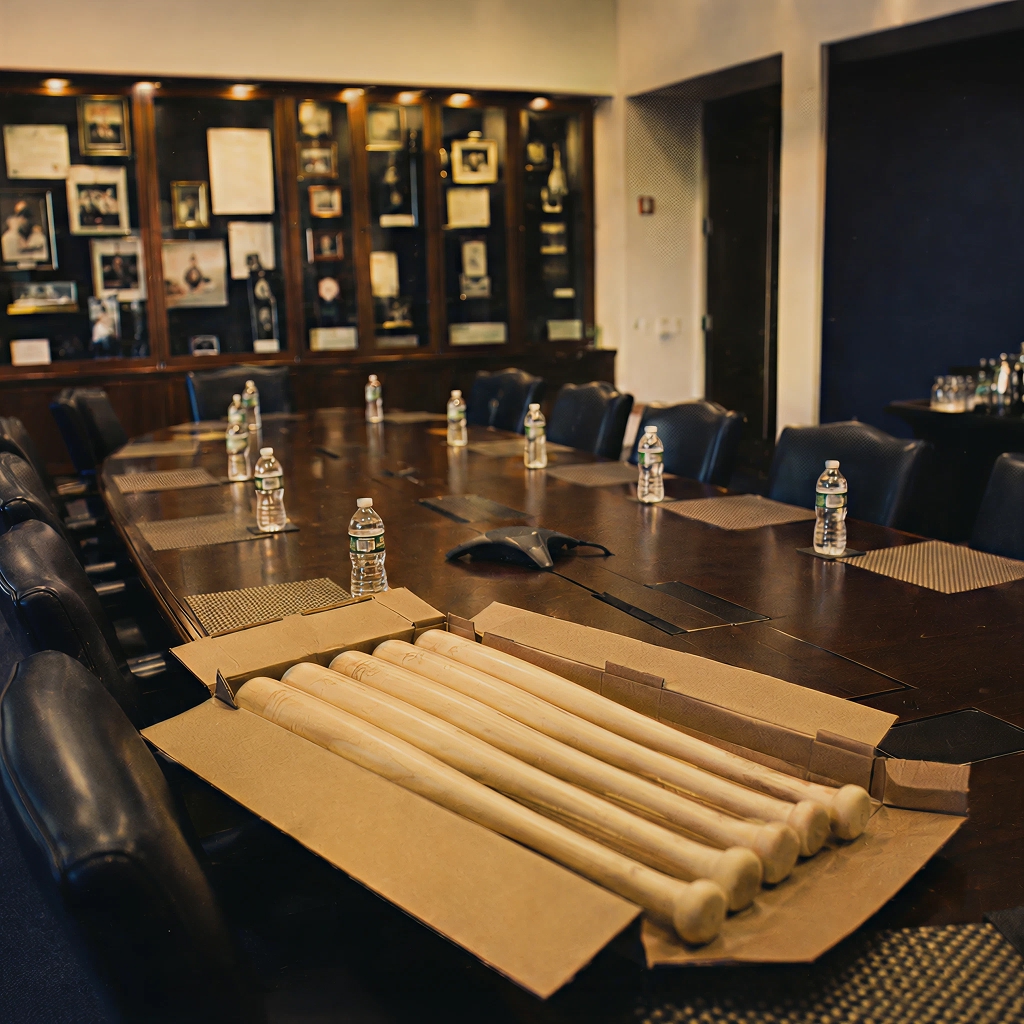
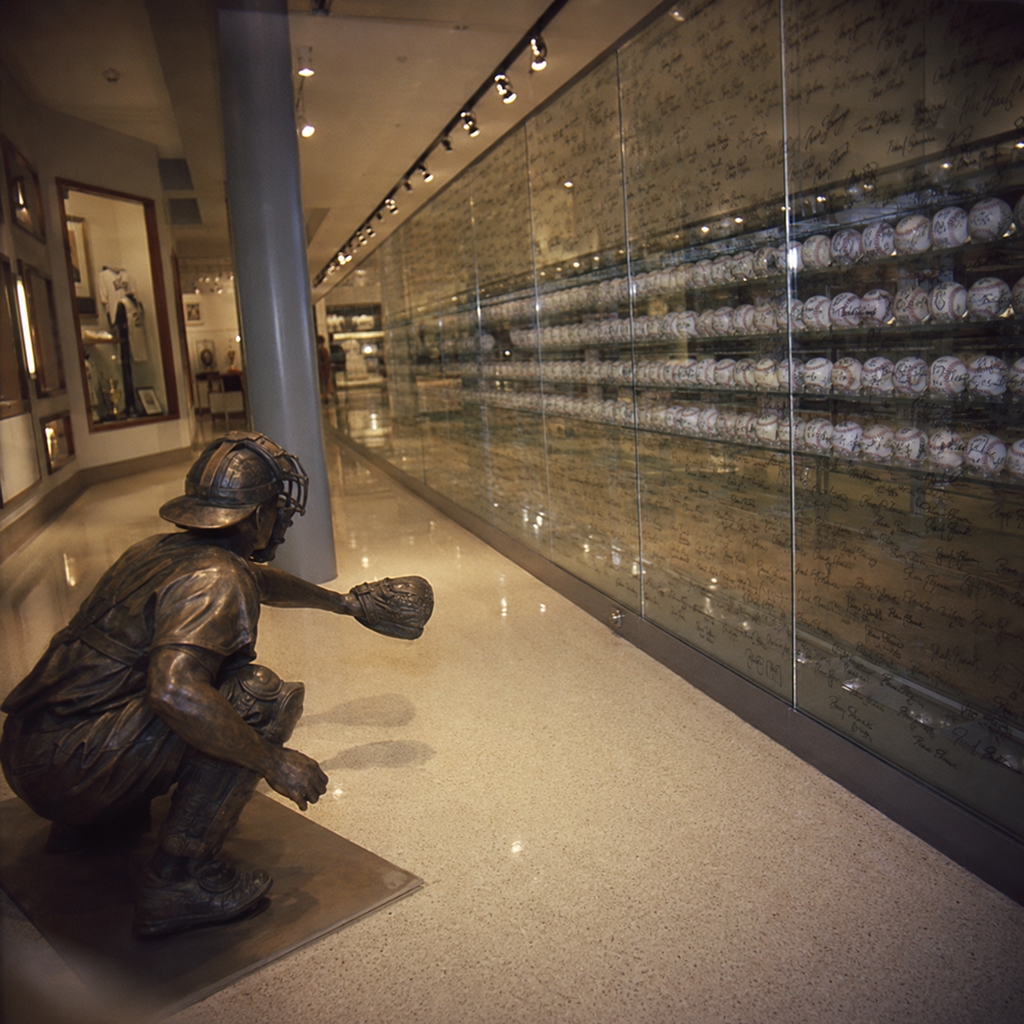
Every door this trip has been a service hall and a kid with a clipboard who half-knew we were coming. This one was a woman in a blazer at the players' gate with our two names printed on a sheet, a laminate for each of us, and a sentence nobody in this business had said to us yet: "We're so glad you made it." She walked us up through a long hall of glass cases and bronze statues — signed balls, the relics of names the place had kept, more of them than I bothered to count — and then into a boardroom with good chairs.
The first man was one of ours — equipment, sixties, a gut over his belt, hands like Voss's. He took a bat and turned it and talked grain and weight and the mountain, and he and Cecil turned out to have spent the same winter in the same league forty years back, and for ten minutes it was the thing Cecil does better than anyone alive — two old men bent over a piece of wood, turning it to the light, in no hurry, certain there was nothing in the room that mattered more than the grain. I could have watched it all afternoon. Then he turned to me and said it easy, kind, not knowing what he was saying: "And that piece you wrote about his brother. My wife read it out loud at the dinner table." He meant it as the nicest thing he had. He was looking at me when he said it. Cecil looked at me too.
Then the door opened and a younger man came in — communications, lanyard, a tablet under his arm — and the meeting changed shape. The equipment man stepped back. Nobody told him to. It just stopped being his room. The young man was warm and quick and reasonable. He said the dispatches had helped them understand what the bats meant. He said people connect with a story. He said their fans would love this — a man who'd given his whole life to the game, out on the road with a wagon full of lumber. Every word of it was true.
They wanted six bats. They insisted on paying for them — a real number, in black ink. He wanted a photograph. He wanted, if it wasn't too much, to get our people at Wallop on a call so the messaging could line up. And he had the dispatch open on the tablet, because there was a line in it he thought they might use, and he turned the screen around to show Cecil — proud of it, like a flattering photo of the man himself.
Cecil had never read one. It was a thing between us that he didn't read them — that's your business, not mine, he'd told me early on, and he never went back on it. So the first dispatch Cecil Tate ever read was the one I wrote about his brother and his fifty years and his peace, off a stranger's tablet, in a room they'd brought him to because of it.
I watched him read it.
The room kept moving around him. The young man was still talking — to me now, since Cecil was busy — about rolling it out the week of the Fourth, the country turning two hundred and fifty, a man and his bats and his story good as made for it. A woman came in and stood a little backdrop in the corner, set a stool in front of it, told us whenever we were ready, no rush. Somebody slid a form across the table for a name and a number; the pen was dry and they went to find another. The six bats were stacked in a cardboard flat by the door. Everyone in the room was happy and busy and getting what they'd come for.
Cecil read it slow, the way he does everything, his thumb at the edge of the glass. Then he pulled the screen back up to read a part again — the part I'd written about his brother, and his fifty years, and the peace I'd decided he'd come to. He read it twice. Then he pushed it down to the last line. For a moment he didn't move, and the busy room didn't notice. The young man was still going about the rollout when Cecil set the tablet down on the table, face up, and he didn't look at me. He said it to the young man. "You don't need me for this part." The young man took it for modesty, and thanked him for it.
We took the order. Cecil's name and number went on the form, because it's his network the whole thing runs on. Then there was a second form — a photo release, two lines, two signatures — and we signed that too. Somebody asked what time would be good to get Gary on a call.
Then they stood us up in front of the backdrop with a couple of men from the club, a bat the club had just paid for held up between us, and the woman with the camera asked us to smile. I smiled because she was waiting. Off to my right she kept after Cecil — a little more, Mr. Tate… there's one — and she asked him more times than she asked me. Then she had her shots. Nobody behind the camera saw a thing wrong; it was the best news anyone had brought them all week. Beautiful, gentlemen. One more.
Gary texted from the Wallop home office before we were out of the building. This is HUGE, it said. Told you the writing would do it. I put the phone in my pocket.
That night Cecil wasn't at the hotel when I came back up with dinner, and his bag was gone from where it had been. I'd carried up two plates from a place on the avenue, a thing with rice he'd have liked. I ate mine. His went cold on the dresser. He didn't pick up his phone.
He told me once, driving out of Knockwood, that the reason he kept going was that he didn't have anywhere else. He had somewhere else. He went.
Wednesday was a day game and I went to it. I went because if Cecil Tate is in this city he is at a ballpark. I bought one ticket — the first time all trip I'd bought just the one — and watched the Detroit Assembly Line beat the Uniques in eleven innings, six to two. For three months Cecil had read me the game from the seat next to mine. There was a stranger in that seat now who didn't say a word to me, and I couldn't have told you the first thing about what I was watching.
My phone went off in the seventh. Naomi. He's okay, it said. That was all she sent.
I started to write down what that meant. Then I didn't.
— Freely
Fantasy baseball without the homework.
Want in for the 2027 season? Leave your address and we’ll send one note when leagues open in March.