The Good Day
Bats distributed: six, counting the two we left in Baltimore on a maybe. A seventh somewhere up a friends-and-family chain in Atlanta — placed or not, no telling from here.
The heat broke somewhere on the parkway. We came up out of D.C. under the same white sky that had been sitting on the city for a week — the sky that put Cecil in a hospital bed — and a few miles short of Baltimore it just let go. A wind off the water, a temperature you could stand in, and by the time the harbor came up on the right it was almost cool, the kind of June afternoon you forgive the rest of June for.
Cecil rode up front with the window down a couple inches and his phone in his hand, thumbs going. Del — the Washington man we'd been driving up to see the Monday his heart went out from under him, the one who'd come up the aisle at our last game there and taken both his hands and said forget the bats — was in town with his own ballclub, the Standing Committee up the road to play the Baltimore House of Usher, and the two of them had been texting since we crossed the line. "He says Saturday," Cecil said, and set the phone face-down on his knee, satisfied, a man back at his work. "Says he'll walk me in to their equipment fella here." Eleven days off a heart attack and he was lining up a clubroom from the passenger seat like nothing in him had moved.
I felt good. Better than I'd felt in weeks — better than the whole trip had let me feel. The man beside me was alive and back to complaining about traffic. The sky had quit trying to kill us. The harbor went by full of ships, actual ships, tall ones with masts and rigging, gray Navy hulls tied along the piers for some anniversary the whole country was working itself up to, and a pair of jets came over low and loud and left the people on the promenade with their phones in the air. Cecil watched them out of sight and then went back to his phone. I thought: maybe we'd finally earned an ordinary afternoon.
We ate at the Lexington Market, because I'd read there was a market and because Cecil will take a market over a restaurant every time — more to look at, he says, and nobody standing over you. It's an old place, the kind I trust, a couple hundred years of people buying their dinner under one roof, made over new but not ruined. I've got one like it at home — Pike Place, up over the water, where I spent fifteen years of Saturdays before I sublet the apartment and drove off into all this — and the thing a market like that teaches you is to walk the whole floor before you buy anything. So I walked it.
I was shopping for Cecil. There's a version of the new rules where you eat the inside of a plain chicken breast and nothing else until you die, and I was not going to let the first real food town we hit be that one. I went stall to stall reading the hand-lettered signs for the thing that would clear the doctors and still be worth sitting down to, and I found it three aisles in: a counter doing rockfish off the Chesapeake, greens you could get without the ham hock if you asked — and you had to ask, and I asked. I carried him back a plate a cardiologist would sign off on, and he ate it without a word of complaint, the way he's eaten everything since the stent, a man keeping the new rules because the new rules are the price of more baseball.
And then, with him settled and eating, I let my mind and feet wander toward the crab cake. I was in Baltimore. It's the thing the place is famous for, almost an obligation. So I got it — Faidley's, four generations of it, a thing the size of a softball with hardly a thought of filler in it, and the Old Bay on it alone would have tripped every alarm the doctors hung on Cecil.
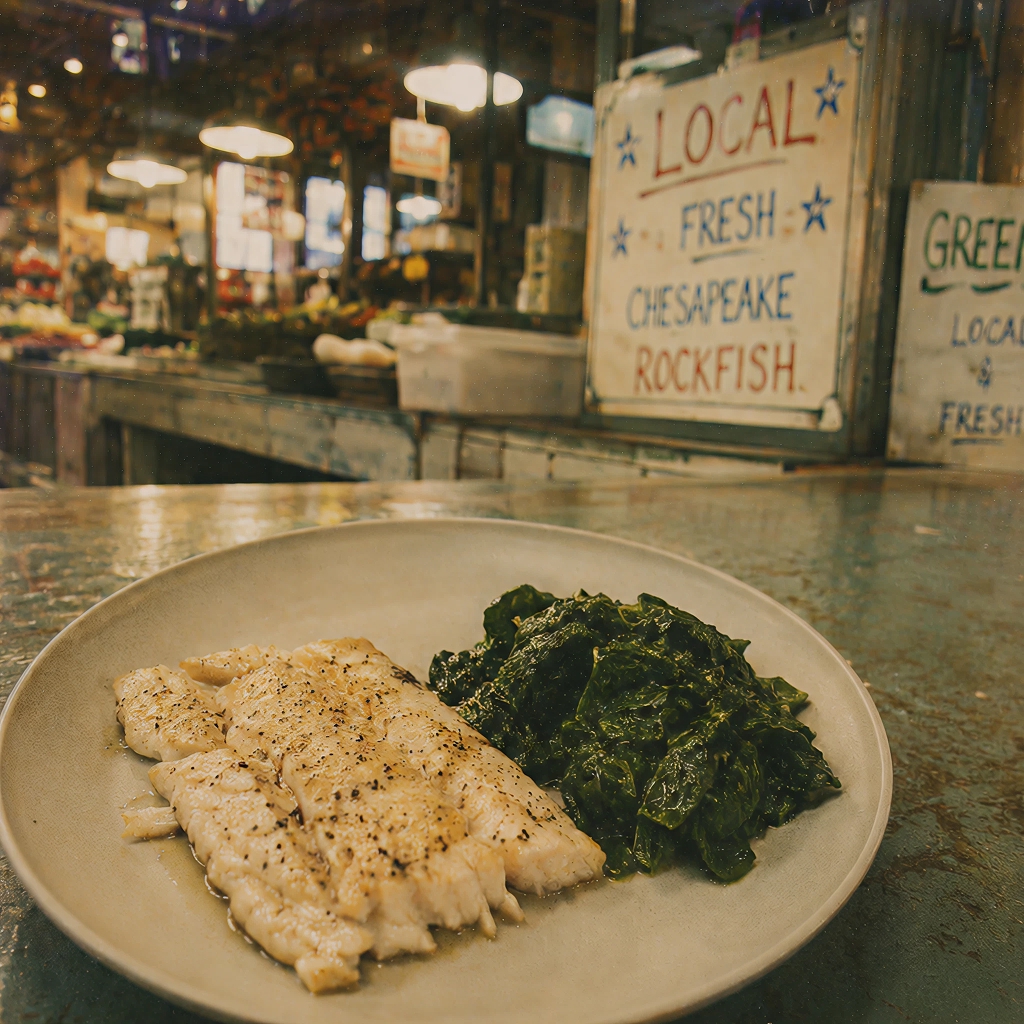
I took a picture of his plate and sent it to Naomi. Eating right. Greens and all. She'd gone back to New Orleans earlier in the week with a promise pulled out of me at the bottom of it, and I meant to keep her posted, and I did. I framed the good plate and left the crab cake out of the shot.
And while I was at it I did the thing I'd quit doing in Washington. For a week and a half I'd handed over a card and not watched the number. I'd let a man at a brick rooming house bill me slow and looked the other way, because there are weeks for the arithmetic and that hadn't been one. This one was. So I paid the two plates in cash, the way I do when I'm paying attention, and what I carry for a day and what two plates cost haven't been the same number in a long time. It felt like getting back to normal. He's on a diet anyway, said the back room of me that has done this math for years. Cecil watched me fold the difference into my shirt pocket. He didn't say anything. But his eyes came up off the greens and sat on me a moment too long, and I told myself it was nothing and ate my crab cake.
There was the matter of the station wagon and the bats. I had The Wire in my head — I'd watched it through twice — and I had just under forty bats' worth of company property in the back, and I was not going to be the man who explained to the Wallop home office how a station wagon full of volcanic Douglas fir got cleaned out in a city I knew from prestige television. So I paid for a garage. Attended, twenty-eight dollars for the night, downtown rates, a man in a booth. And then, because the man in the booth didn't settle me, I carried a dozen sample bats up to the room anyway, two trips, sweating through my shirt — the same way I'd hauled the whole forty-eight into a motel in Phoenix back in the spring.
Nothing happened to the wagon. It sat in its attended garage under its man in the booth and was exactly how I'd left it in the morning. The twenty-eight dollars was real and the sweat was real.
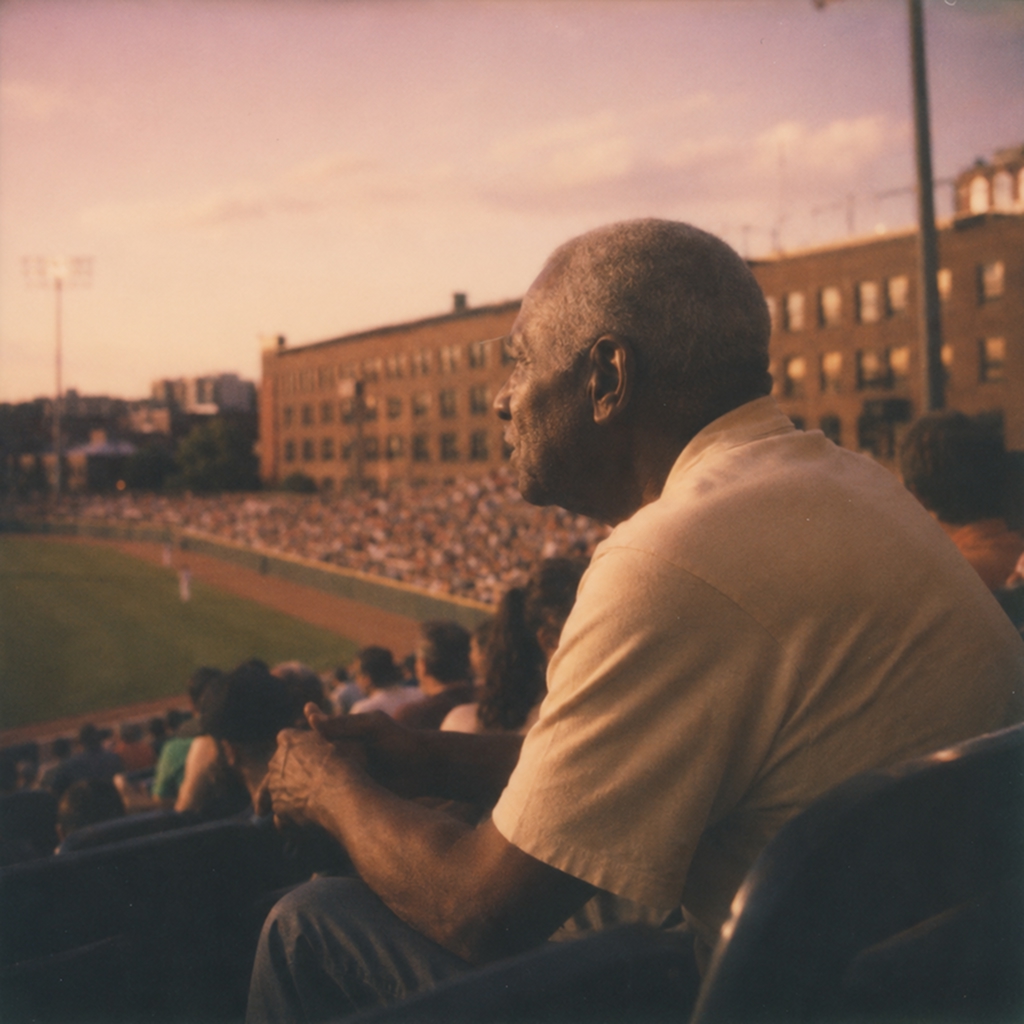
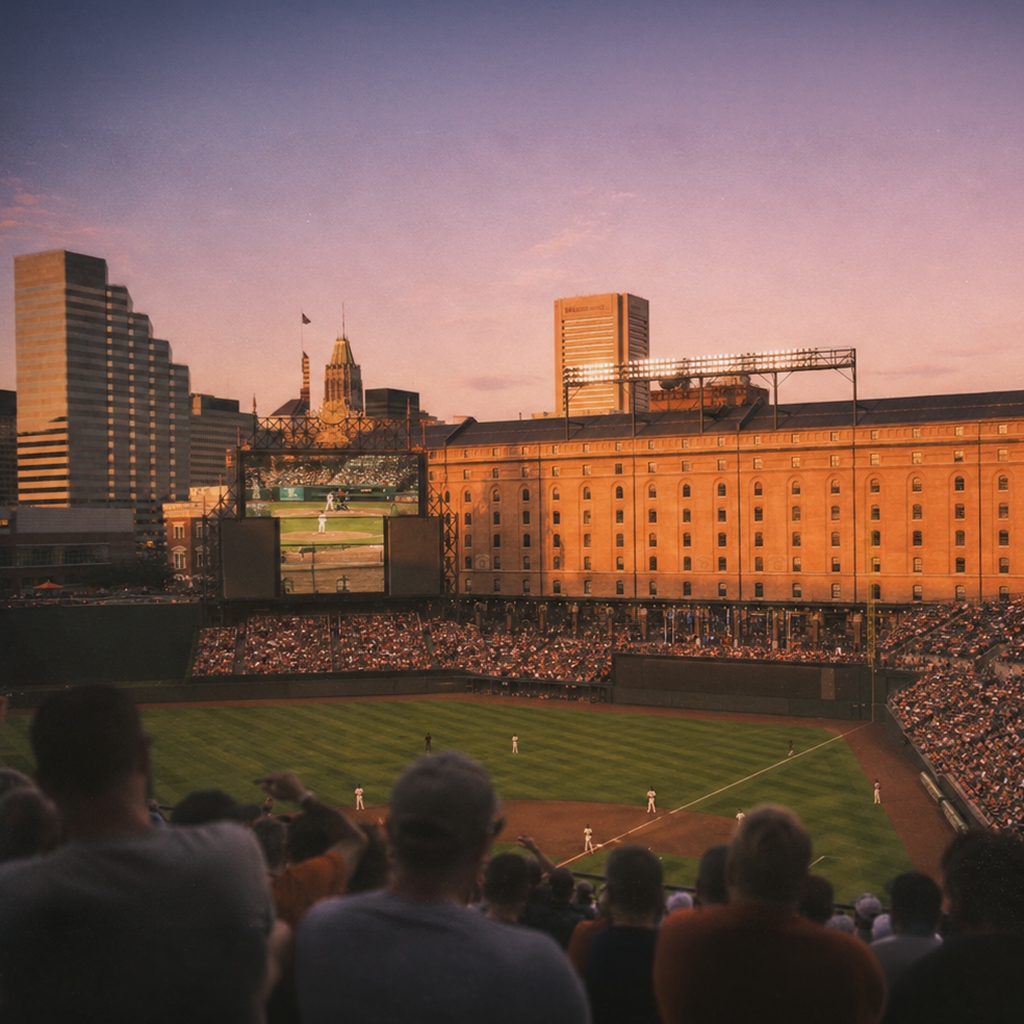
The ballpark is the old beautiful one, the warehouse along the back of it the better part of a quarter mile of brick, the park every park since has been trying to be. And the name just sounds right for baseball: Camden Yards. The Ushers had the Standing Committee in, a beltway thing — Washington's only an hour down the road, and half the building was wearing the other team's colors and enjoying it. Twenty-seven thousand on a Friday, a good crowd, the warehouse going gold and then pink as the sun got down behind it.
Cecil took it in from our seats. He didn't go down to the rail the way he had in every park since February — he'd sat the whole night the last time out too, and I'd let it be — but he watched the way he watches, every pitch getting the same weight, no inning beneath his attention. In the second he told me the Washington kid at the plate was sitting dead-red and would chase nothing else, and two pitches later the kid chased nothing else and walked, and Cecil didn't say a word about it, because to Cecil it isn't a trick, it's just the reading. A vendor came through and he bought a bag of peanuts he isn't allowed and ate exactly four and handed me the rest.
It was a clean game and nobody hit one out. Think about that. I have driven this man around the country for three months on the premise of a single thing — the ball over the wall, the only thing that moves a Wallop roster — and on the best night I'd had in weeks, in one of the prettiest parks in the country, not one soul on either side managed the only thing I'd come to see. The Ushers won it three to one on singles and a double, a starter named Rogers carving the Washington lineup into the seventh, a closer slamming the door. I said something to Cecil about the whole trip riding on a thing that hadn't happened. He watched the field a second and said, "Plenty of game without it." He'd have watched the same nine innings if nobody had bothered to keep score.
In the seventh a man two rows down turned around. Fifties, Ushers cap, a beer in each hand. He looked at Cecil a second longer than a stranger looks, and then he said it. "You're the bat fella. From the dispatches." Not to me. To Cecil. "Good to see you on your feet. My buddy sends 'em to me. That last one about the wall — the brother — that about killed me." He reached back up over the row between us to get a hand to Cecil, beer and all, an awkward long stretch of a thing, and the two or three people he reached past turned around to see who was worth it. "Honor," he said, and meant it, and folded back down into his seat.
Cecil shook the hand and said something gracious and small and let it go, because to him it was a small thing, a stranger in a cap, the kind of thing that happens. From the dispatches. A man in a ballpark in a city neither of us had ever set foot in, and he knew Cecil Tate, and he knew him because of what I'd written. A stranger with the brother, the wall, the worst day of Cecil's year in his two beery hands — and what I felt, God help me, was proud. I felt read. Fourteen weeks I'd kept myself small in these, kept the lid screwed down, written what little of the man he handed me and not one inch more. Somewhere in that seventh inning the lid came loose.
Saturday I followed Cecil down into the underneath of the ballpark, the way I've followed him into a dozen of them since March, and watched him do the thing he actually came out here to do.
Del met us by a loading door, big laugh, both hands, a long look at Cecil to satisfy himself the man was really standing there — you scared the hell out of all of us — and then he walked us down a cinderblock hall and made the introduction the way you hand a friend something you've been saving. The Baltimore man was an equipment fellow named Voss, heavyset, a towel over one shoulder, a guy who'd seen every salesman the game ever produced come through that hall. And I watched Cecil work.
I have written before that Cecil is a different size indoors, down in the rooms where the game actually lives, and Saturday was the clearest I've seen it. He didn't pitch. He never pitches. He put a bat in Voss's hands and let the wood do the first minute of talking, and he talked about grain and about the mountain and about a winter the two of them turned out to half-share through a coach in Tucson, and inside of ten minutes Voss had stopped enduring a sales call and started having a conversation he was enjoying. Two clubrooms in one afternoon, a Washington man and a Baltimore man, and Cecil moved between them like a key that fit both locks. It is what he is for. It is what he is good at.
It came to a maybe. Voss turned the bat over a last time and handed it back and said leave him a couple, he'd swing them in the cage, he'd ask around, no promises — the gentlest, most professional version of the door I've watched close on us in city after city. Cecil thanked him like he'd said yes. Out in the hall he told me it was a good meeting, and he meant it, and he was right. It was exactly as good as these get. We left two bats with a man who'd think about it and carried the rest back out to the wagon in the heat.
Sunday morning, before we loaded up for New York, I sat down to write.
I'd meant to write the weekend — the market, the ballgame, the cinderblock hall, Cecil working Voss with the wood like he'd done it ten thousand times, which he has. The honest account of Baltimore is a capable man who worked two rooms in an afternoon and came away with a maybe. But that isn't the thing that wouldn't leave me alone.
What wouldn't leave me alone was the seventh inning Friday — the man two rows down, from the dispatches, and what it set loose in me and hadn't taken back. It sat with me all weekend, through the clubrooms and the polite maybe, and Sunday morning with the ships still out the window I thought about Del's words back in Washington, the ones I'd been turning over for a week. Forget the bats. He'd said it with both hands around Cecil's hand, an old friend just glad the old friend was alive. And I decided I finally understood it.
I have written the bats for three months. The grain and the volcano and the sound off the sweet spot, the protocol, the count that goes up and gets reset to zero, the equipment men and the polo shirts and the long slow no. I wrote the bats because the bats were the assignment. Today I'm going to write the man. Somebody ought to, while there's time, and there's nobody else who will, and there's nobody who has watched him the way I've watched him these three months, and Del is right. Forget the bats.
So here is the part I've never put down. Cecil Tate gave fifty years to this game. He came up in the same dirt, the same boarding houses, the same long bus rides as men whose names you know — and the names you know got kept, and his didn't, for no reason a box score will ever show. I'm not going to tell you he would have been a star. He'd wave that off, and he'd be right to. He was a ballplayer, a good one, a lifer, one of the ten thousand the game runs through and uses up and never thinks of again. That isn't a tragedy of talent. It's quieter and worse — a lifetime handed over, taken, and the name not even kept.
And that's what I can't get out of my throat this morning. For fifty years this man has stood at the edge of it — the cage, the rail, the tunnel, his hand on the fence — close enough to lay a palm on the thing that wouldn't have him, and he has not complained, not once, not to me. He'll tell you the wood's not bad and tell you nothing else. So let me say the rest, since he won't, since somebody ought to before it's over: this is the last lap of one of the forgotten ones, taking the only tour the game ever thought to offer him — a back seat, a stack of bats nobody wants, a string of ballparks where if we're lucky a stranger turns around and knows him for the length of an inning before the game moves on. I came out here to sell lumber. I've decided, somewhere up the parkway with the heat finally off us, to do the one useful thing a man like me can do for a man like him. I'm going to write it down. I'm going to make it so that when this is over, a stranger looked at a screen and knew what Cecil Tate was.
He says plenty of game without it and he means it — and a man does not come to mean that on his own. The game teaches it to him, season by season, until the wanting wears down to something that holds still and looks like peace.
He'd hate that I wrote it. He'd hate every word. That's how I know it's true.
— Freely
Fantasy baseball without the homework.
Want in for the 2027 season? Leave your address and we’ll send one note when leagues open in March.