Knockwood
Bats distributed to date: six.* Equipment managers contacted: eight. Status of the field correspondent: returned, with company, to the lower parking lot.
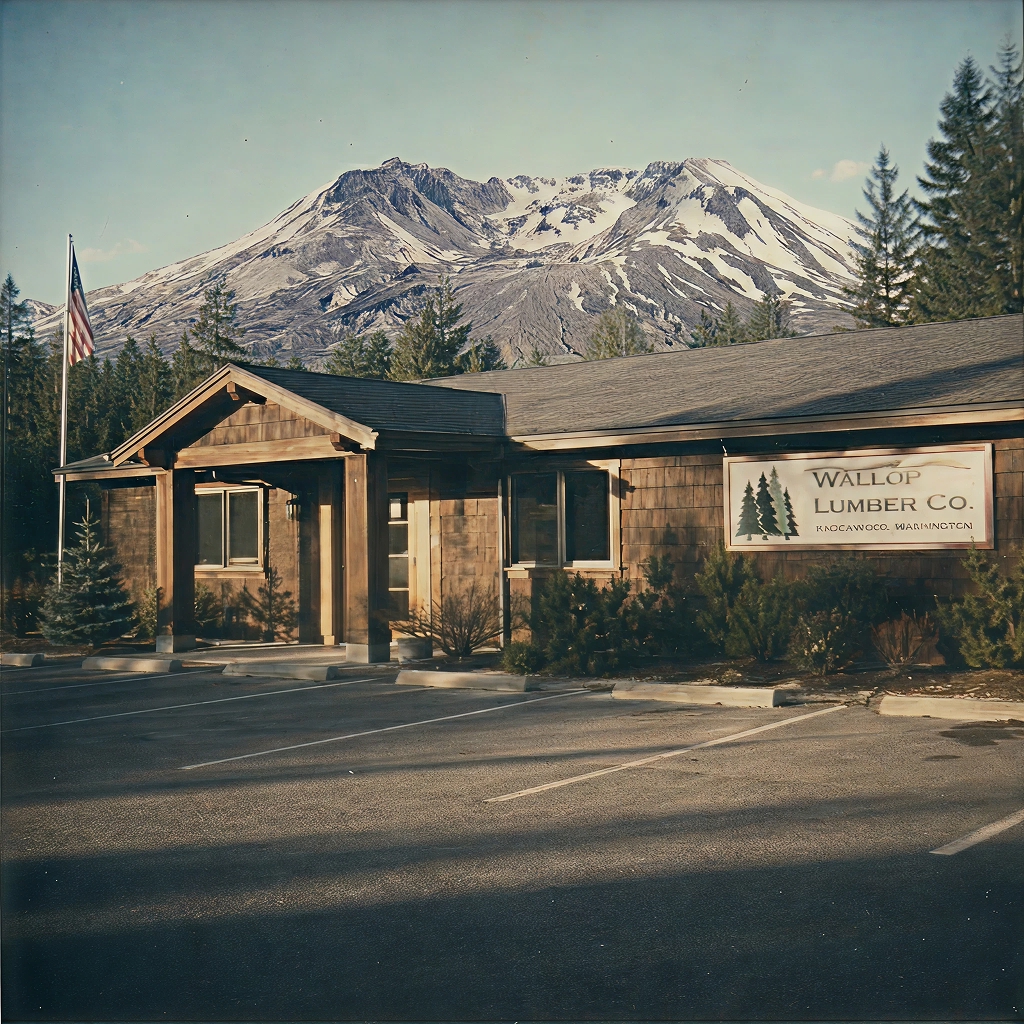
The lower parking lot at Wallop Lumber Co. looks the same as it did on the nineteenth of March. The pavement is cracked along the same line. Mount St. Helens, viewed from this lot, is in the same position it was the morning I drove out of it.
What is different: the wagon is six bats lighter, and there is a man named Cecil Tate in the passenger seat.
"This is Knockwood," I said.
"The H-Q," Tate said.
I had imagined this moment for weeks, my optimism gradually waning until yesterday's sharp rebound. I could pull into this lot with a small triumph to file.
The walk from the lower to upper parking lot to the front entrance is not far. I led Tate up the path as though I had been here more than the one time. He, in clubhouse-corridor clothes, crossing a rustic forest parking lot, was visibly the visitor. People in lumber towns do not, as a rule, look like Cecil Tate.
Inside the lobby a young woman was waiting for us. She introduced herself as Tabitha. She wore a Wallop polo a half-size too generous and a small cross on a thin chain. She offered her hand with both formality and warmth, which I had not seen anyone do in a while.
"Mr. Keach is in a meeting," she said. "With the owner. He's so sorry. He'll be free this afternoon — he was hoping I could give you the tour and take you both to lunch in the meantime."
Gary hadn't mentioned any meeting with the owner.
"Of course," I said.
Tate, polite: "Sounds fine."
"He really is so sorry," she said again, with the earnestness of a nineteen-year-old in her first professional setting.
The tour began in the offices, with introductions to people whose roles had nothing to do with our project. We shook hands politely and continued on.
Tabitha, a marketing intern, had clearly prepared. She also had questions that were not prepared, which she asked walking between rooms.
"I've read all your dispatches. How long have you been on your road trip?"
"Five weeks, give or take," I said.
"So — are you guys friends now?"
It is a question that arrives the way a pitch arrives — in the strike zone before you have decided whether you are swinging.
"We are… colleagues?" I ventured, the equivalent of a check-swing.
Tate, eventually: "He's all right."
Tabitha had been trying to make conversation with two men she had been reading about, and the question had been, to her, the obvious one. I had been writing without ever having to answer for any of it in person.
The Marketing office is down the corridor. It is a different kind of room — three monitors per desk, a wall of color-coded sticky notes, a printer humming in the back next to reams of Wallop paper stock.
"You guys are playing the game, right?" Tabitha asked.
"Wallop. The home run game. Everyone's been playing it. My boyfriend is obsessed." She smiled at the screen. "Which is great, right?"
I leaned in to look at the familiar website. My team in our Wallop employee league was tenth of ten, where it had been since week two. Above me in third place: Tabitha.
The adjoining monitor showed weekly active users climbing.
"It's getting some good traction," she assured us.
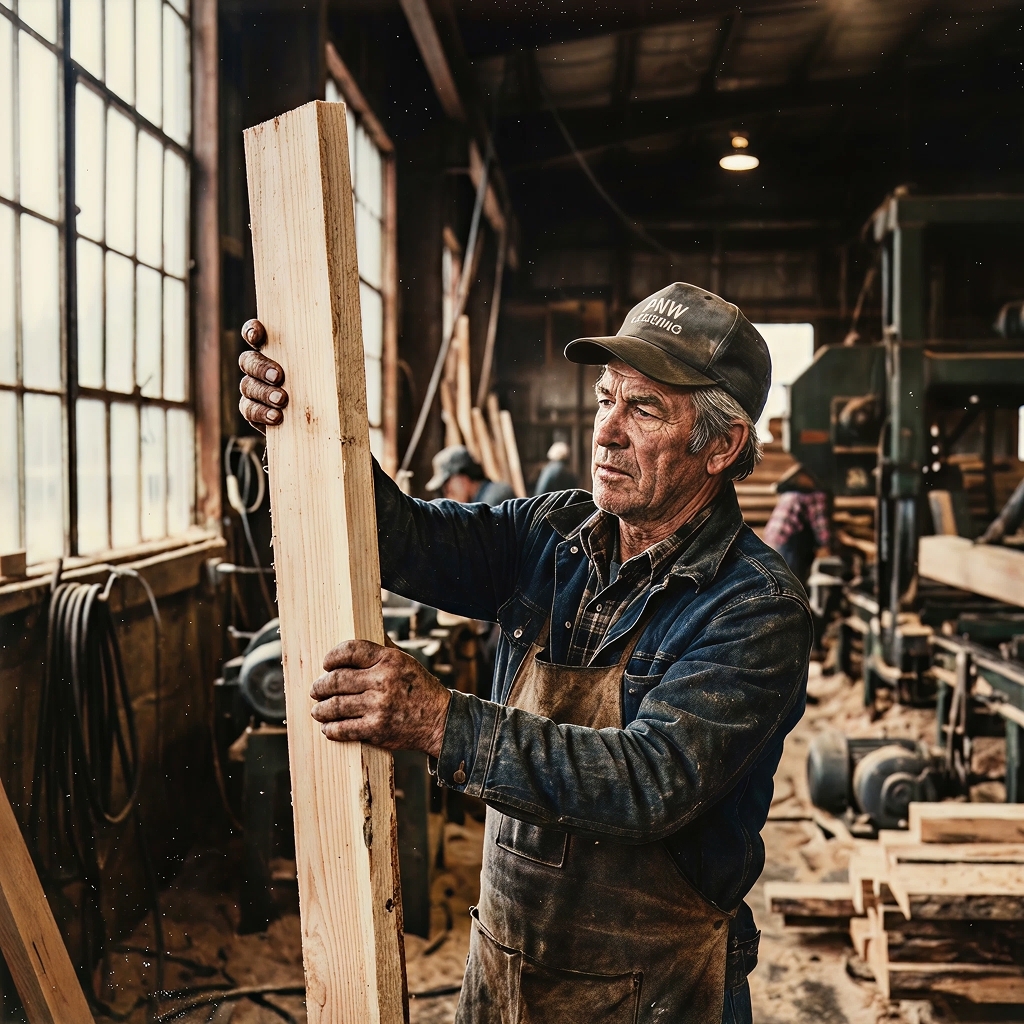
The mill floor smells like green wood and warm machine oil. It is the smell of the actual operation behind every sales pitch I've given and every paragraph I have written about volcanic soil and proprietary mineral content. Mount St. Helens, from the yard window between the planer and the stacking line, is closer than it is from the lot. It feels enormous.
Tabitha introduced us to Roy, the foreman. Roy was a compact man in his sixties with calloused hands that had spent decades doing what they were doing now, which was holding a length of new-growth fir up to the light.
"Roy's been here longer than the building," Tabitha said.
"I've been with the company since before Knockwood," Roy agreed.
"I believe he's also the reason we got connected with Mr. Tate."
"Walla Walla," he said. "1977 and '78. I was at every home game my last two summers of high school. My dad worked the mill at Pendleton, we'd come over on the weekends. I'd kept tabs." Roy looked at me. "You know who this is?"
"I do."
"You're the writer? Tell me you've covered the Ozzie Smith thing."
I was at a loss.
Roy turned to Tate. "We had the two of you in Walla Walla. Two shortstops, both good enough to start. But you could tell there was something special about the one even before they called him The Wizard. My dad said he was destined for greatness, but I always thought you were the better pure hitter, even after they shifted you to second."
"Now he's in Cooperstown," Tate said.
I filed that carefully.
"It's an honor to meet you all these years later," Roy said. "Let's get some of these bats into the majors, am I right?"
The tour moved on. Tate kept a steady gaze ahead. Tabitha, walking ahead of us, looked at me once over her shoulder and did not say anything.
I had been writing whatever fraction of Tate he had shown me.
Lunch was in a conference room with a window that faced the mountain. Tabitha had set out four plates for a casserole of ground beef and noodles and cream-of-something with a cracker topping — plus a basket of dinner rolls and a pan of bars cut into squares. I had not seen lunch like this since I had stopped going home for Christmas.
"It's from my church," Tabitha said. "The ladies do most of the company functions. I hope this is okay."
"It's fine," I said, and meant it.
Tate took a bite, paused, took another.
"This is good," he said.
"Mrs. Holcomb made the bars," Tabitha said. "She always does."
We ate. Tate had two helpings of the casserole. I cannot remember seeing him eat two helpings of anything.
Mid-meal, Tabitha leaned forward and said in almost a whisper, "I've been wondering…"
I gestured, eyebrows raised, trying to draw it out of her.
"Do you actually have to travel to all thirty stadiums? Like — there are two teams at every game."
Of course I had thought of that. I nodded repetitively while reaching for a response, the gist of which was that the project was not really about coverage in the sense that two teams per game would solve. It was about the shape of the trip — visiting every park, every region, each fanbase and ground crew. They were a piece of writing that has a form, and the form needs integrity. I felt, while speaking, that I was justifying something different than the thing she had asked about.
Tate, eventually: "She's not wrong about the math."
Tabitha looked at him. Then at me.
A minute later, finishing her last bite: "Marketing is so excited about the game. They want to start putting some of that energy on the dispatches too."
After lunch, Tabitha excused herself. Gary's meeting still hadn't broken. The dessert bars sat untouched.
After a while, Tate said, "They're talking about us."
"Maybe."
Gary came down the hall a little before three. He had the face of a man who had been in a room for a long time. He shook my hand and gave a quick embrace that conveyed the slump of his shoulders.
"Marshall. Mr. Tate. I am so sorry about today. Let me walk you out."
"Walk us out? Is everything alright?"
"Yeah, I — let's get some air."
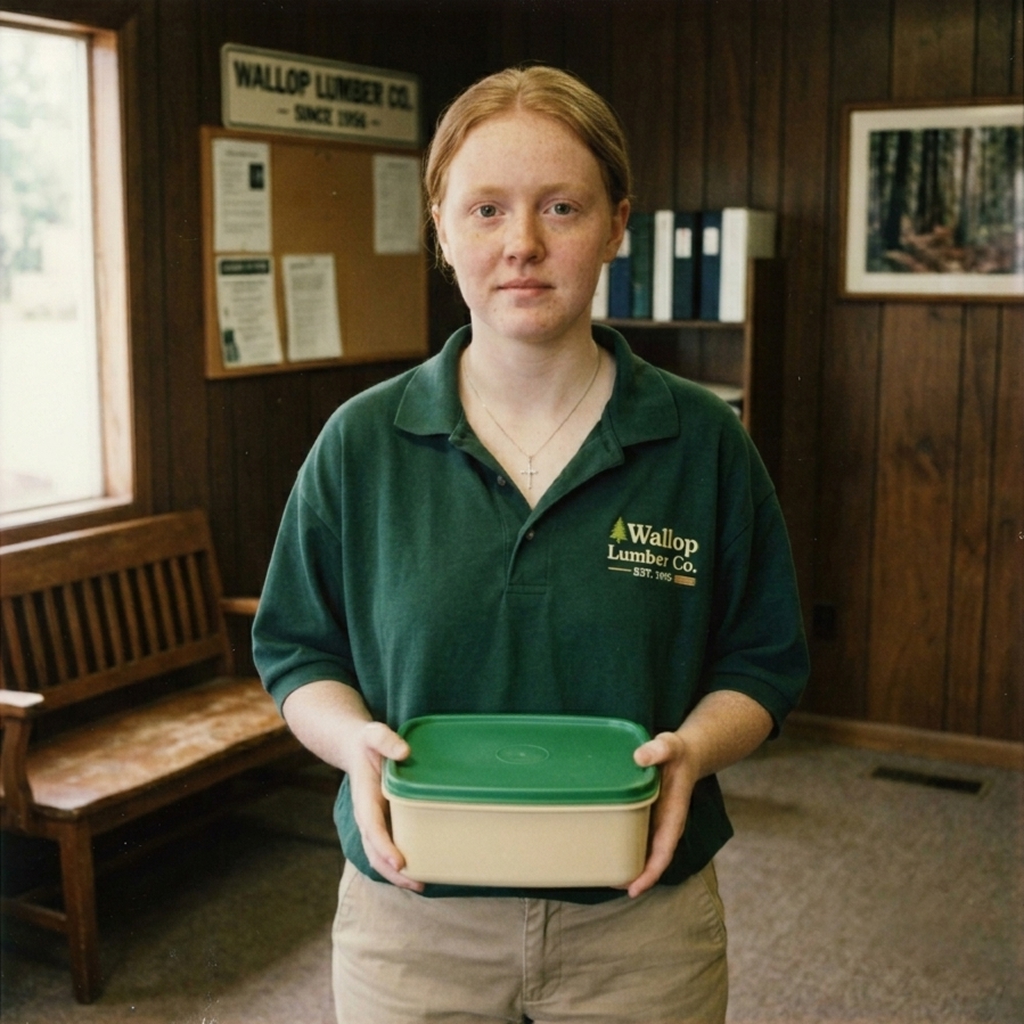
Tabitha caught up to us in the lobby as we crossed it. She held a Tupperware container in her hands.
"For the road," she said, and offered it to Tate, who accepted. She considered for a moment, then hugged me, briefly, with the same formality and warmth she had offered her hand, and then she hugged Tate, who let her.
"I can't wait for the next installment," she said.
She let go. She stepped back. She waved with both hands at the door. Gary was already a step ahead of us, holding it open. We followed him out.
The walk down the slope from the upper lot to the lower lot is short. Gary did not say anything important on it. He talked about his kids, who I had last seen in a Christmas card photo, and about a fishing trip he was hoping to take to Montana in August, and about the weather.
At the wagon, in front of the open driver-side door, Gary said the thing he had walked us out to say.
"Marshall. About the count."
"Okay."
"Look, I personally am thrilled you got some bats in the hands of the Hops. And I was just trying to sell management on this idea of yours — that seeding the minors with Wallop bats can carry us into the majors."
I actually hadn't thought of that.
"But what counts for them is getting our bats directly in the hands of the big boys. The Hops aren't — they're not what we mean by the count. I should have been clearer at the start. The count is for major league teams. That's the number the home office is tracking. Which is…"
"Back to zero," I said.
"Yeah. I'm sorry. It's just putting me in an awkward position."
"You don't need to apologize, Gary."
"I'm apologizing anyway."
He looked at the mountain, the wagon, then to me.
"How's the Roadmaster holding up?"
"No complaints."
"File Seattle," he said. "Let's talk next week. Are you going to see family while you're up there?"
"I don't know."
He shook Tate's hand. He squeezed my shoulder once. Then he turned and walked back up the slope, alone, toward a building where a meeting was waiting to reconvene.
I stood at the wagon for a moment. Mount St. Helens, viewed from the lower parking lot, filled exactly as much sky as it had filled five hours ago but felt heavier.
"Six," I said, to nobody.
"Mm."
We got in. I started the wagon. We pulled out of the lower parking lot and turned south, the way we had come in, and the mountain slid into the rearview the way it had the morning I drove out the first time. The man in the passenger seat had a Tupperware on his lap and was looking down at it.
"I don't know. Maybe we should just call it."
"Thing is," Tate said, "I don't have anywhere else."
Somewhere on the slope down, a bit of gravel kicked up by a lumber truck ahead struck the windshield on his side and produced a small star-shaped crack.
— Freely
* The Hops. We're working on it.
Fantasy baseball without the homework.
Wallop is a home run-only game for friends — simple enough to play all season without the daily grind. Start a league and draft any time before September.
Start a League