Spoken For
Bats distributed: twelve. Hitters in town this week: the forty-odd best in the bigs.
You don't walk a wagonful of bats into an All-Star Game. There's no clubhouse to find the side door of, no equipment man leaning on a cart with an afternoon to kill — there's a rope, and a lanyard, and the men you'd want to hand a bat to are the men the rope is for.
I came down from Queens on Friday anyway, into a city that had decided not to take the party down. The bunting from the Fourth was still up on the row houses — why strike it, with the ball game coming — and All-Star Week had hung its own over that, so the whole town was red, white, and blue twice over. Philadelphia is where they signed the country into being, two hundred and fifty years ago this month, and the game had brought its midsummer carnival to the birthplace in the birthday year, which somebody in an office is very proud of having thought of. Banners on every pole. You could not buy a cup of coffee without a commemorative sleeve on it. Down in South Philadelphia the Fraternals' park sat lit up in the middle of it like a fairground.
They swept the wagon at the perimeter — a week like this, understandably — and one of the officers opened the tailgate on a load of Douglas fir and stood there a moment, recalibrating his afternoon. He drew a bat out, turned it over, looked down the grain, weighed it in one hand — held it better, honestly, than some professionals I've offered it to — and racked it again with care. The cooler he opened, looked into, and let alone. Forty of the game's best hitters inside that fence, and the only man in Philadelphia to take one of our bats in his hands all week was making sure it wasn't dangerous.
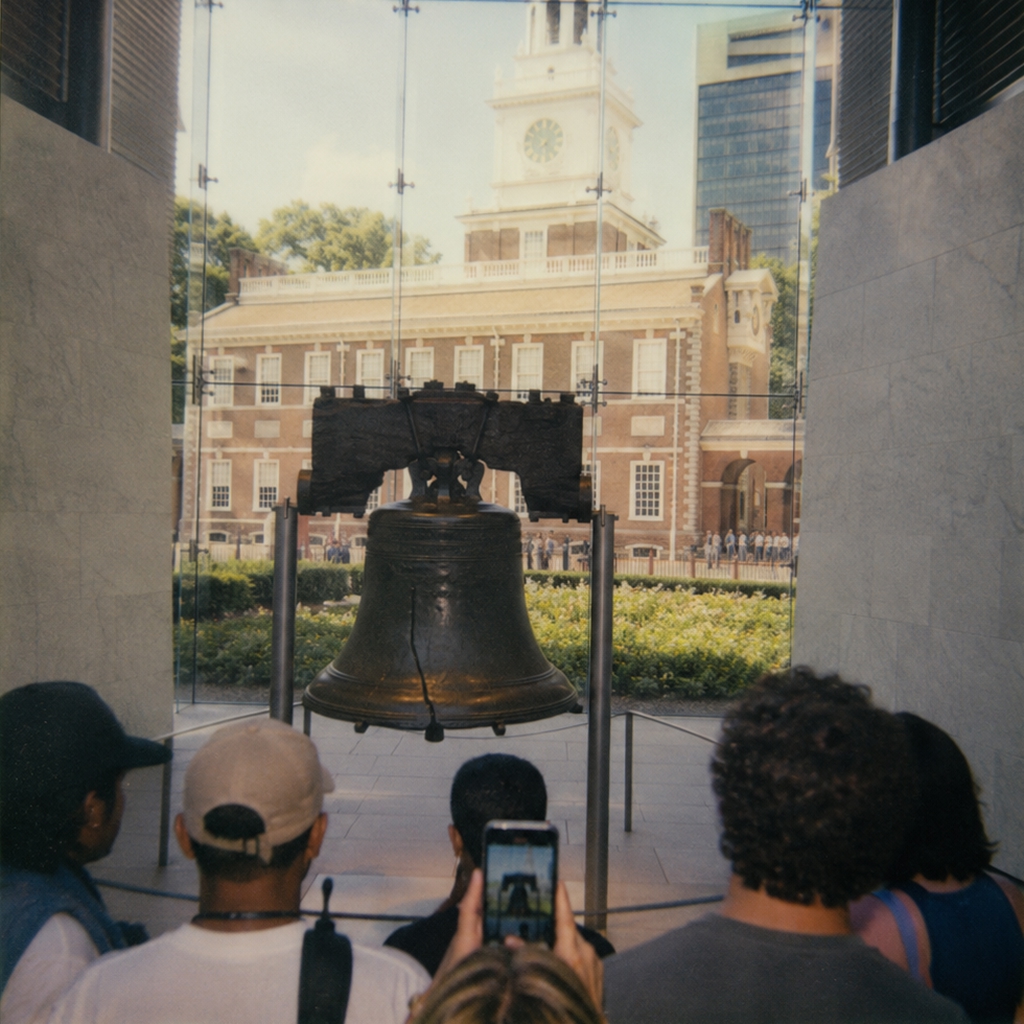
Sunday, with nothing on the sheet, I walked up through the old blocks and stood in the line and looked at the Liberty Bell with everybody else in America. It's a bell with a crack in it. The crack is the part everyone photographs. On the walk back I ate a soft pretzel off a cart, three dollars with the mustard, and it held up all week against heavy competition on the company card.
The competition started that night, at a steakhouse off Broad Street, because Gary was in town.
I had seen Gary Keach in the flesh twice in four months — the lower parking lot at the start of it, and the day he reset the count — both times on Wallop asphalt. Now here he came across a dining room in a Wallop campaign polo, arms out. Gary in person is Gary on the phone plus wingspan.
He'd earned the mood, or somebody had. The New York Uniques' money had cleared. The campaign was, in the official word from marketing, performing — our two faces and some Photoshopped red-white-and-blue bats out on the country's feeds for its birthday. And the phone at the home office had started ringing with baseball men on the other end of it, and the baseball men were asking for Cecil.
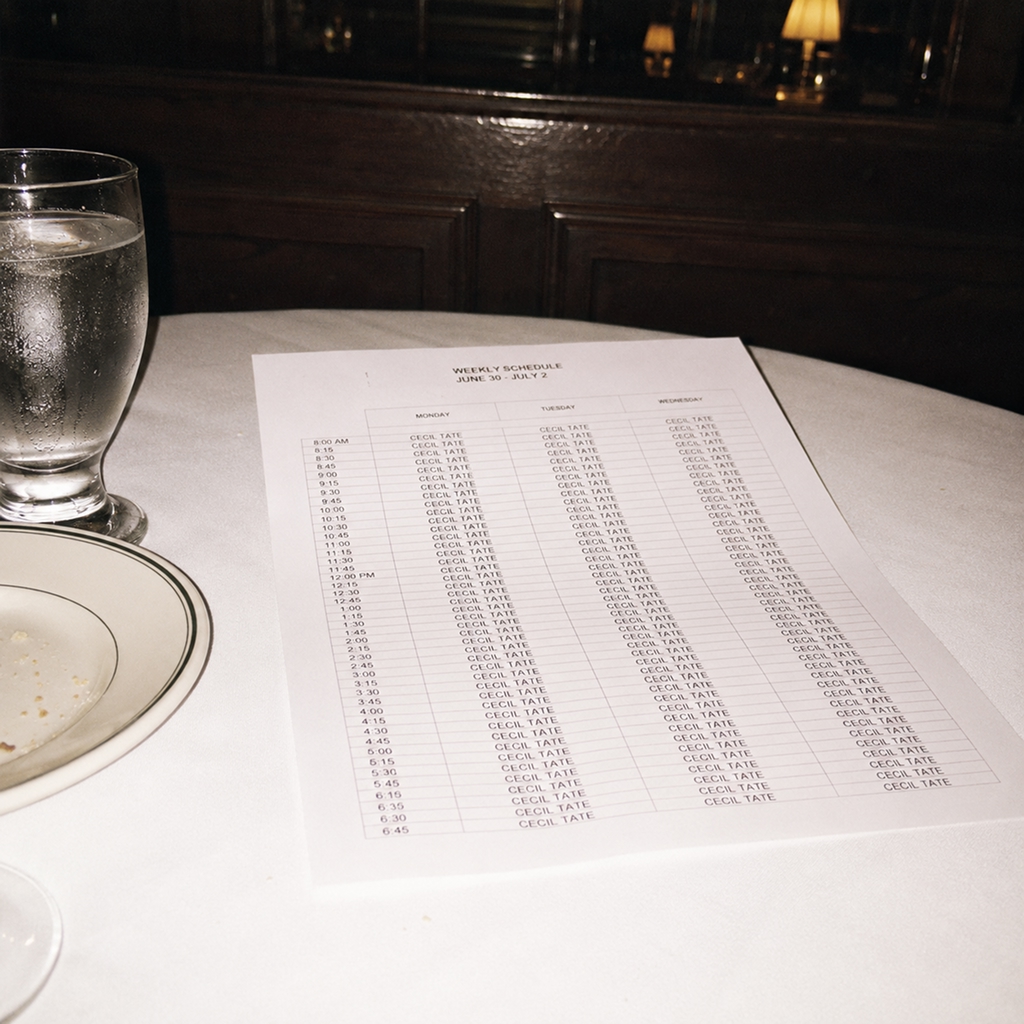
"Our readers love him," Gary said, and meant it as the finest thing one man can say about another. He slid a printout across the tablecloth: the week in fifteen-minute blocks, Cecil's name down the whole length of it. Mine appeared twice. "He's spoken for clear through Wednesday," Gary said, happy as I have ever heard him. "Eleven-forty tomorrow, Thirtieth Street. You'll want to be early."
Somewhere in there he asked where I was staying. I named the motel, and heard myself move it three blocks east, into a better neighborhood than the one it sits in. Gary looked at me for about half a second — a man starting a piece of arithmetic, the per diem against the neon — and then the entrées landed, and Gary has never once finished a piece of arithmetic in a good mood.
I was at Thirtieth Street by eleven, which gave me forty minutes to work out where to stand.
Cecil Tate came up into that big marble room at eleven-forty, carrying the bag he'd carried out of the Bronx thirteen days ago. He looked fine. Rested. He'd gotten a haircut somewhere along the way. I watched him find me — I was back by the departures board, twenty feet off, behind a family and their luggage — and he came over at his own pace and stopped a fair distance out and said, "Marshall." My name, read off a list. I said his back. I didn't offer my hand. There were two ways that could have gone and I couldn't have stood either one.
The wagon was up on the second level of the garage. I was getting the tailgate open — it sticks, has stuck since the Rockies — when his hand went to the cooler latch beside it, the way it had gone in every state we'd crossed, to check the ice nobody had asked him to check. Then it stopped, and he took the hand back. "Need—" he said, and let the rest of it go, and walked around and got in the passenger side.
We drove into town over the river with the radio off. Four months that man read me the country out a car window — every grain elevator, every high school backstop, every town some catcher he knew came out of. He watched it all go by now like any passenger. At the hotel his room was in his own name, booked by the home office; there was nothing in any of it for me to see to. He took his key and said he'd be down at four.
He was down at four.
The Derby was that night, under every light the grid could spare — eight men hitting baseballs at the moon while forty-four thousand people counted them off out loud.
In the concourse a man in a fresh Fraternals cap stopped in front of Cecil — "You're the bat fella, the red-white-and-blue ones" — and put out his hand, delighted to have found him. Cecil shook it and said he was.
Gary had three seats down the first-base line, good ones, on the company, and Gary positioned himself in the middle one.
The crowd booed every man not in a Fraternals uniform at the introductions, one at a time, to be thorough about it, because the town had two of its own in the eight — Kyle Schwarber and Bryce Harper — and no use for the other six. This is the city of brotherly love, and anyone who ever suffered an older brother knows precisely the love they mean. The order had the two of them hitting back-to-back at the end of the round, for the last chair: Harper came up short of Schwarber's number, and the evening settled onto one set of shoulders by nine o'clock. And they booed a kid from St. Louis named Jordan Walker — twenty-four, first time asked, cap on backward, a wad of gum going. At the end of his first turn Cecil said, to the air in front of him, that the kid was the most composed hitter in the bunch. Gary made a conversation of it. I watched the balls come down.
Late in the night Cecil's phone lit in his shirt pocket, and he took it out, and from two seats away I knew the name on the screen without trying to. He read it, thumbed something short back, put it away, and clapped for the next one. My own phone had the weather on it.
The final was Schwarber and the kid, and Schwarber hit eleven, and the park stood up to be handed the thing it had come for. Walker came to his last ball needing three just to tie, four to win, the first miss the end of it — and he hit four, the same swing he'd had in the first round, each one landing in a sound like a building having the air let out of it. Then it was done, and the kid was the champion, and Cecil clapped for him slowly and said nothing more. He'd already said it.
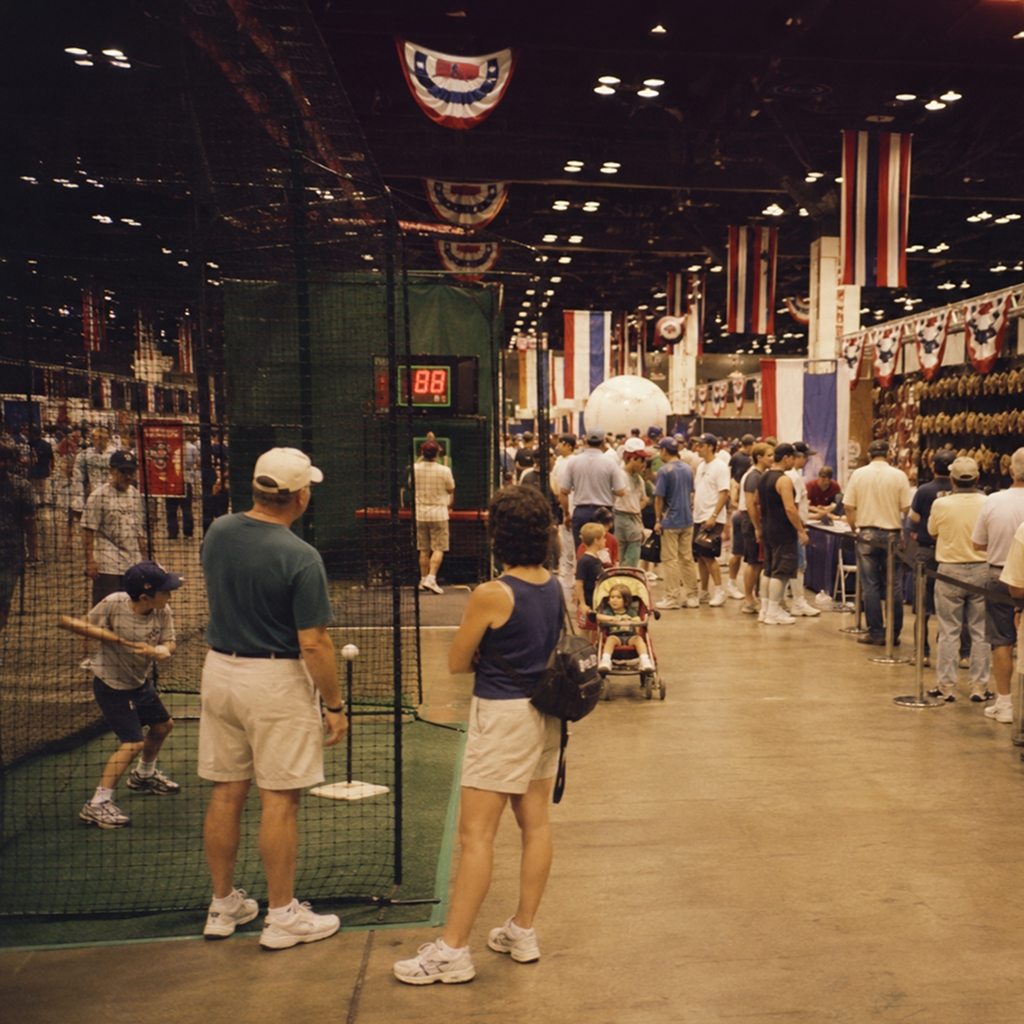
Tuesday they had the convention hall done up as a carnival of the game — cages, radar guns, a wall of gloves, kids swinging off tees, men my age in line for autographs from men their age. Cecil was on the printout for the afternoon, and Gary steered us across the floor half a step ahead, introducing the place like he'd built it.
The equipment man found us mid-floor. Big, sixty-some, twenty-odd years with a club in the middle of the country, a lanyard heavy with pins. He wasn't wandering. He'd seen Cecil across that hall and come straight over. "You're Cecil Tate," he said, hand already out, and inside a minute they were down in the wood — grain, kilns, the mountain — and Cecil was easy in it, hands going. Nobody had introduced them.
After a while the man wanted a photograph, and he looked around for somebody to take it, and handed me the phone. I took three and told him the middle one was best.
Then, gathering himself to go, he got to the part he'd crossed the hall to say. The pieces, he said. His clubhouse passed them around. His wife had read him the one about the brother in the car, across two states. Forty years in the game, he said, and it was the truest thing he'd ever read about it. He said it straight to Cecil, and he meant every word.
Cecil thanked him. The right amount, in the right voice. If you had not spent four months in the front seat of a station wagon with the man, you'd have seen nothing happen at all.
The game itself was Tuesday night, the ninety-sixth of them, and before it they put on the birthday and the ballgame at once — a fife-and-drum corps in colonial dress out on the outfield grass, "America the Beautiful," a movie star reading an essay about baseball and the country while the whole park's phones went up to capture it. Then the introductions, which are the best part of the whole week and I won't be argued with: they called them out one at a time along the baselines, every name its own verdict. Cecil stood and clapped for all of them, and whatever he knew about each one — and it was plenty — stayed where it was.
The American League won it four to nothing, on pitching, which nobody prints a poster of. Fifteen strikeouts. A game like that is played in six inches of air, and from the seats you cannot see it at all unless somebody reads it to you. Nobody read it to me. The home team's own starter gave up three in the first inning of his own park, which is a hard thing to ask a city to absorb twice in two nights. And in the week the sport threw the country a festival for the home run, the game itself allowed exactly one — a man named Miguel Vargas, in the eighth, four hundred and thirty-three feet, the only unscheduled fireworks of the night.
We stayed to the last pitch, the two of us, out of the same habit. When it ended Cecil shook my hand — he shook my hand — and said the home office had us both going up to Boston, and we'd sort the schedule in the morning. Then he said good night at the elevators and the doors took him.
Gary flies home tomorrow with a folder of numbers that are all real. Cecil and I drive north, the two of us. The sheet says Boston, and it says two of us. It didn't say we were going together. It has never known the difference.
— Freely
Fantasy baseball without the homework.
Want in for the 2027 season? Leave your address and we’ll send one note when leagues open in March.