The Run of the Place
Bats distributed: twelve. Bats left on the desk of a man I never met, in an office nobody stopped me from walking into: one.
The New York Outer Borough Club plays in Queens, in a good brick ballpark named for a bank, and I came into the city Wednesday against the tide of eight million people who had come to look at boats. The tall ships were still tied up along both rivers — ships from thirty countries, the radio said — and every human being on the eastern seaboard had come down to stand at a rail and look at them. I sat in the wagon on the approach for the better part of an hour with a car full of Douglas-fir and inched toward the one ballpark in New York that week almost nobody wanted to go to. The only place in the city with parking.
I should say what the job was, because for the first time since Arizona, all of it was mine to do. Cecil wasn't answering his phone. He knew the equipment manager here — a name he'd said on our drive up to the city from Baltimore, said like it went back years — and I called that man four times over two days and got a voicemail box that was full and stayed full. That was the network. That was all of it. It lived in a phone in a pocket I couldn't find, in a state I didn't know.
Not that the club would have noticed a man with bats. They'd fired their manager twelve days before, run off after his infield made six errors in a single game, which is a thing I did not know a professional team could do. Six. They were in last place and losing the way a team loses when the year is already gone. There was a game to play that afternoon while I was inside the building. I felt for them.
Thursday was a getaway day, a one o'clock start, and I did it the honest way first. I found the guest services window and asked, hat in hand, who I might speak to about equipment, and the young woman there looked at me the way you'd look at a man asking to speak to the weather. She made a call that went nowhere and another that went nowhere after it. Somewhere in the building a phone was ringing in an empty room; I could all but hear it. She was sorry. Everyone was going to be sorry all week — I'll say it once now so I don't have to keep saying it.
So I went to get the bats out of the car, to at least try it with my hands and not just my mouth. Cecil would have already been in that clubhouse, drinking their coffee. I carried three of them in from the lot — Cecil never once carried a bat, I want that on the record — and came in through a door a man in a polo was propping open with a folding chair while he fought a hand truck of bottled water through it. He looked at the load on my shoulder and said, "You the wood guys?" and I said yes, God help me, and he said, "Down the hall, somebody'll grab you," and went back to his water.
That was it. That was the whole of the security I'd spent a career of rejections learning to respect. A man with a hand truck, a folding chair, and a guess.
Nobody grabbed me. I went down the hall.
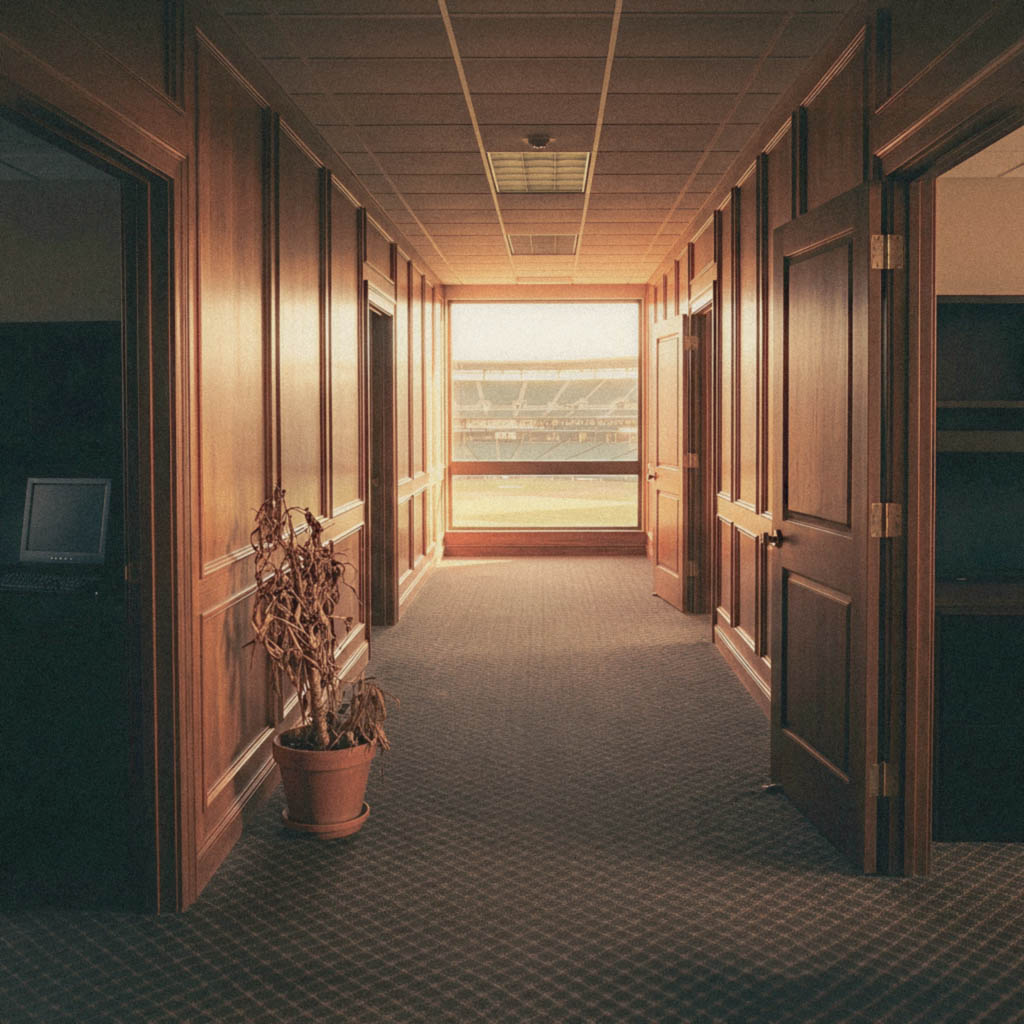
There was no one in the building — not on a getaway day, on a holiday week, in the middle of an eight-million-person boat festival, with the club busy firing everyone. The game was on down below — I felt it more than heard it, the muffled organ, the rise and fall of a disgruntled crowd that had come anyway — and the offices above it were a ghost ship. Every door I passed stood open and every room behind it was empty. I kept waiting for the hand on the shoulder. I kept the sentence ready — I'm with Wallop, we make a bat — and there was no one to say it to. A nameplate for a director of something, and behind it a dark screen and a dead plant. A conference room with forty chairs and last week's lineup still half-erased on the whiteboard. Stairs, because they were there, and the door at the top open too.
The higher I went the better the carpet got. I'll be honest that some part of me was enjoying it. I had spent four months being turned away by twenty-five-year-olds with clipboards, and here I was walking through the middle of a major league baseball team with an armload of lumber and my own reflection getting nicer in the glass. Off the landing there was a little kitchen with a machine on the counter — chrome, Italian, more dials than the station wagon has — and since no one had stopped me yet and I'd started to suspect no one would, I made myself an espresso. It took some doing. It was the best cup I'd had since Seattle, and I carried it down the carpeted hall like a man with a corner office of his own, and for about ninety seconds it was the finest afternoon of the trip.
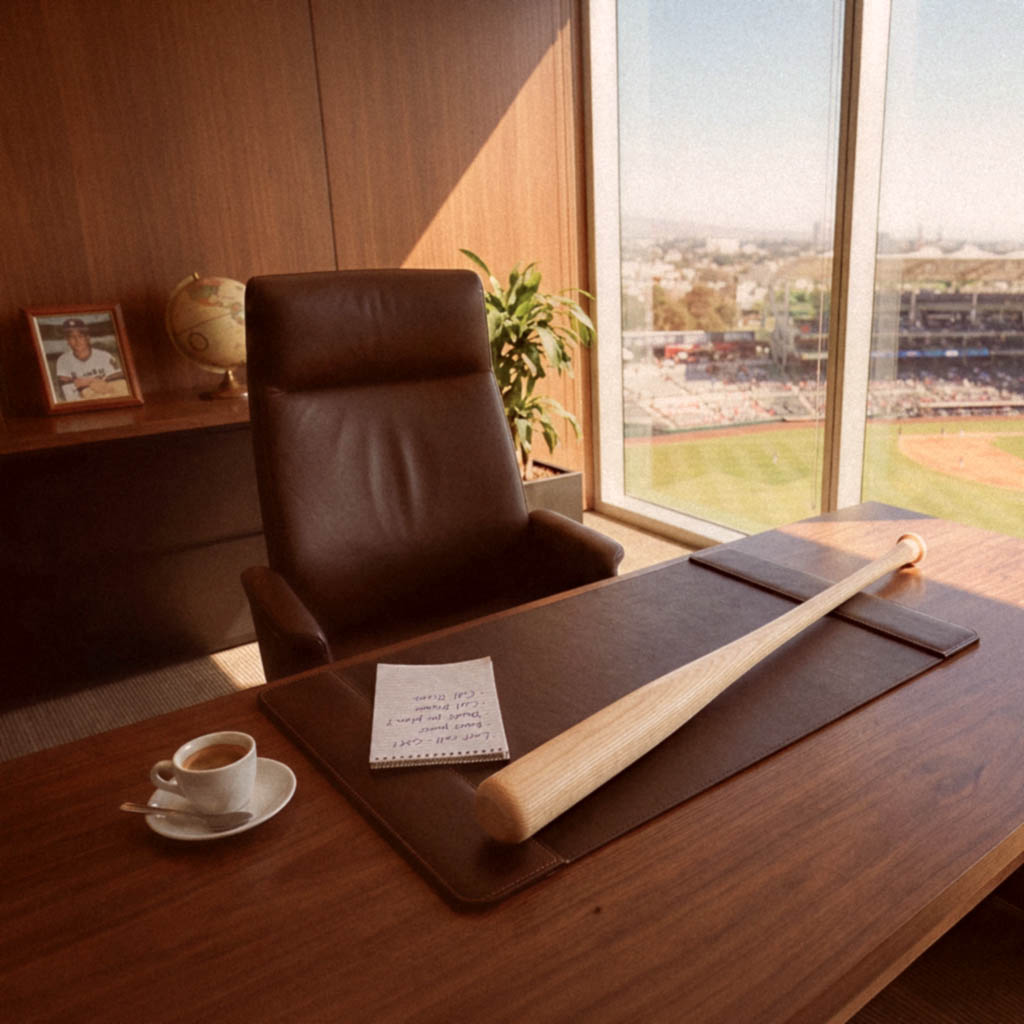
The corner office was at the end, door standing open, a nameplate beside it, and the name on it belonged to the man who runs the whole baseball operation — the one whose platitudes they'd been running all week, no magic bullet, no one thing that turns it around. No one in it. A window framing the field, the game down there small and bright. A desk the size of a dinghy. The day had been walking me somewhere, and this was where it stopped. I set my espresso down and leaned over the desk.
Then I did the thing Cecil taught me at a batting cage in Phoenix in March — the last of the three rules he kept when he crossed out everything else I'd written: get a name and a number before you leave. I had the name; it was on the door. The number I couldn't get, because you can't take a number off a man who isn't there — so I left him mine instead. I wrote him a note on the pad I keep these in — everything Cecil could never get me to say at a rail.
I'd gotten as far as my own phone number when a kid came around the doorway with a laptop bag and stopped cold. Early twenties. He looked at me at the desk, and at the bat on it, and at the little espresso, and I watched his face start reaching for the question. "David asked me to drop one of these by," I said, before he could get to it. "I'm just leaving him a note." I said it flat, like I was giving a stranger the time. His face let the question go. "Oh," he said. "He's not in." "I know," I said. "That's why the note." He nodded, and looked at the coffee one more time, and went off to a desk of his own.
There was a little tray of the man's own cards on the corner of the desk. I picked one up — the name and the number both — and set it back down, because I was never going to have the nerve to dial it. I laid the bat across the blotter where he couldn't miss it, and there was nowhere left in the building to enjoy. I carried my cup back to the little kitchen, washed it, dried it, and put it back, and I went down the hall past the kid's open door not feeling like the run of the place anymore.
And then, because no one had sent me anywhere all day, I didn't go out. I went down.
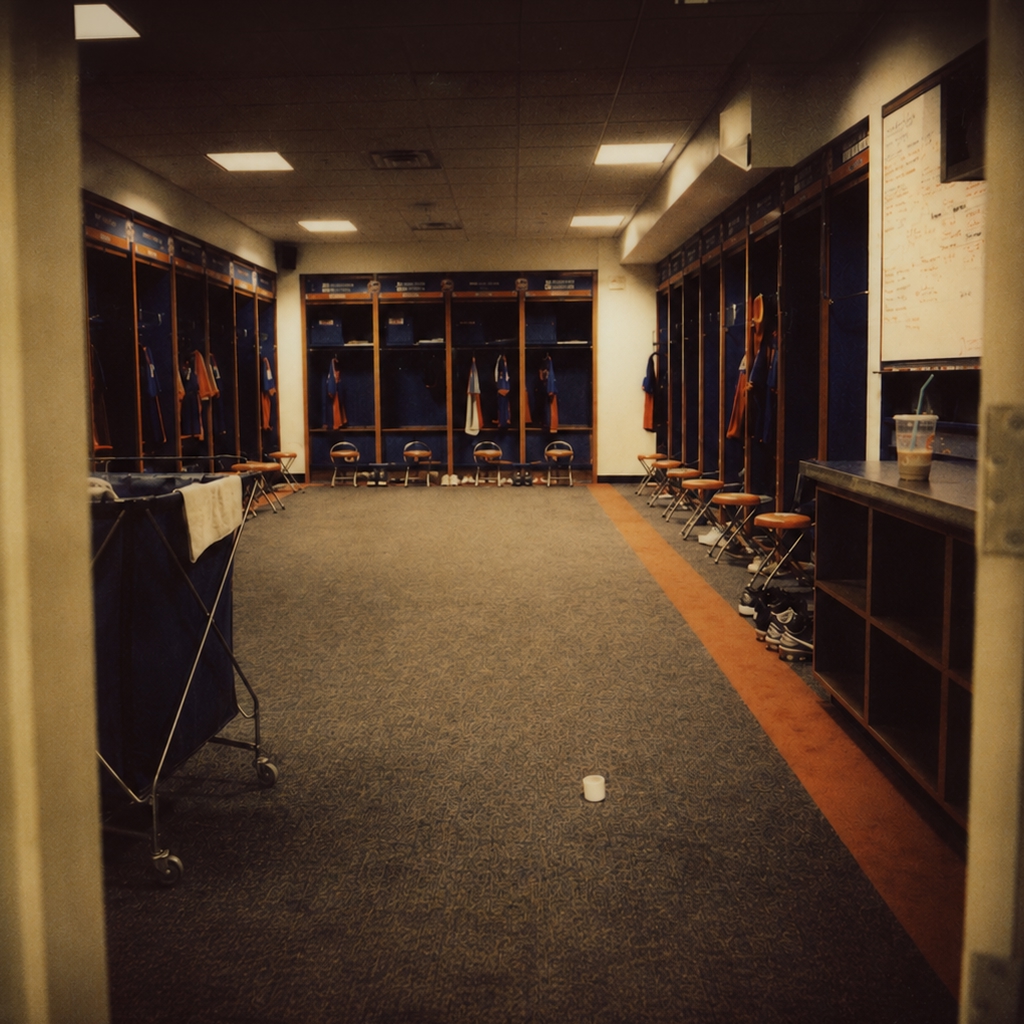
The clubhouse is in the basement, where the important things usually are, and I found it the same as everything else, every door standing open. I stood in the door of a big-league clubhouse — the room I've spent my whole life outside of, the room Cecil walked into in Hillsboro and had a man calling him Coach before we were ten feet in — and there was nobody in it. They were all upstairs, on the field, losing by the sound of things. It was just the room. Lockers in a horseshoe, a nameplate over each. A laundry cart. A roll of tape on the floor where it had rolled. Cleats in a row. Half a cup of coffee gone cold on a shelf. A whiteboard nobody had wiped.
The nameplates were over the lockers, too far in to read from the door. Cecil would have known every one of them without looking. I stood in the door and didn't go in. There was no one in the room to stop me. It wasn't mine to go into.
I went up and out and watched the rest of it from a seat in the corner where the sun was, because after the basement I wanted the sun. There weren't many of us. Getaway day, last place, a city gone to the harbor. The man next to me was about seventy, with a scorebook open on his knee and a transistor radio pressed to one ear though the game was right in front of him, and he was, I want to be clear, wrong about nearly everything. He booed a manager who wasn't managing there anymore. He called for a bunt with two outs. He told me one of the kids was going to be a star, and the kid then booted a routine grounder, which around here you learn not to make a whole thing of.
But he was the only thing in that whole ballpark I could read all day. He'd been coming, he said, since before this building — since the old place with the ramps. I asked him why he still came, a team like this, a year like this, and he looked at me like I'd asked why he still breathed. "Sixty years," he said. "What am I gonna do, stop?"
I didn't tell him what that landed on. I wrote it down instead.
Gary called in the eighth. He was in a fine mood. The campaign had gone out that morning — Cecil's face and mine and the bats the Bronx club bought, all of it wrapped in red, white and blue for the country's birthday — and people were sharing it, and Gary is a man who loves a thing people share. He got to his news like he gets to everything, warmly and a beat too late to keep me from hoping it was something else. Cecil was going to be in Philadelphia. The home office had reached him and squared it — the All-Star break, the big stage, the whole industry watching. Cecil had said yes. "So you'll see him Monday," Gary said, like that was the good part, like he was handing me a gift. And he was. He just didn't know what he was handing me: that the phone Cecil wouldn't answer for me had picked up for the home office.
The game did not end the way the season had been going. The visitors had it early, on a pair of home runs, and then the whole thing turned over on them — the club got even, the other team's center fielder threw a ball away and handed them two runs, Juan Soto hit his twenty-first, four hundred and thirty-five feet into the right-center seats, and the last-place club that couldn't keep a front office lit went out and won it, seven to three, going away. The one thing in that building that worked all afternoon. I sat until the man with the scorebook had folded it into his coat and gone, because he'd earned the last of the sun better than I had. Then I loaded up and drove out. I had the bats in the back, minus one. I was going to see Cecil on Monday, and I'd had nothing to do with it, and I did not know if he'd look at me.
The sheet says All-Star Game in Philadelphia. It still lists two of us.
— Freely
Fantasy baseball without the homework.
Want in for the 2027 season? Leave your address and we’ll send one note when leagues open in March.