The Cage
Bats distributed to date: zero. Equipment managers contacted: three, if you count the churro vendor, which I have been. Bats swung by the narrator of this dispatch: one, under duress. Status of the narrator's left foot: tender.
We left San Diego on Sunday morning. Tate drove the first leg. I didn't ask why he offered; I just moved to the passenger side and let the Roadmaster find its lane. He drove the way he does most things — steady, no wasted motion, one hand at twelve o'clock. The AM radio picked up a Spanish-language station outside Yuma that neither of us changed.
He was quiet in a way that was different from his usual quiet. Tate's normal silence is ambient. This had a shape to it. I had been replaying San Diego in my head — the sound the bat made, the reserve outfielder's face — and I assumed Tate was doing the same. I was wrong, or I was right about the subject but wrong about the conclusion he'd drawn from it.
We pulled into Scottsdale late Sunday. Monday morning, I laid out the day: the Copper Works' home opener against Detroit at Chase Field, first pitch at 6:40. I had identified an Oaxacan place in Roosevelt Row for an early dinner. I had the route to the stadium mapped. I had done my research.
Tate said, "Turn left here."
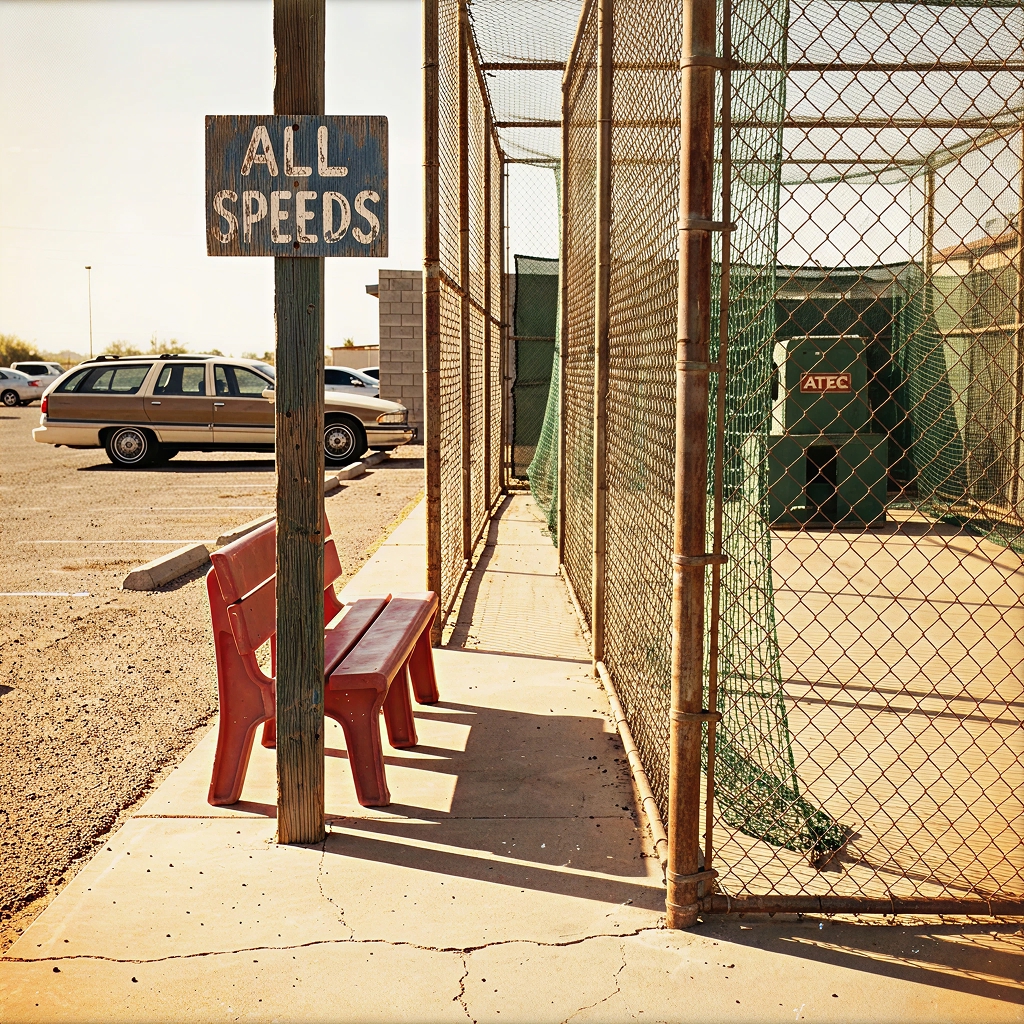
I turned left on Union Hills. We pulled into Casey's SportsWorld, a faded family sports complex at 40th Street that has been there for thirty years — batting cages, mini golf, a turfed arena. The batting cages are called Casey at the Bat. I will not insult the reader by drawing the connection to what happened next. Tate was out of the car before I'd found park. I sat there for a moment with the engine ticking in the heat, looking at a sign that read ALL SPEEDS, and understood that we were not going to the home opener.
He bought twenty dollars in tokens and handed me a bat. A Wallop Lumber Co bat. One of ours, pulled from the moving blankets in the back. "We should know what we're selling," he said. This sounded reasonable. It was not reasonable. He pointed me at the 80-mph cage.
I will not exaggerate the experience of standing in a batting cage with a pitching machine throwing at eighty miles an hour, because the experience requires no exaggeration. The ball left the machine and was past me while I was still committing to the idea of swinging. The second pitch hit the net behind me with a sound like someone snapping a wet towel. I swung through the third, the fourth, and the fifth — each one a full commitment to a location the ball had already left. The last time I had swung a bat was at a company picnic in 2017, and the pitch had been underhand, and I had grounded out to a woman from accounts receivable. On the sixth pitch I made contact — foul, off the handle, a vibration that went up my arms and into my teeth. On the ninth pitch I fouled one straight down into the top of my left foot and said a word I will not transcribe for the regional office. I did not hit a fair ball. Tate was sitting on a plastic bench with his arms crossed.
"Who do we give them to?" he said.
I stepped out. "What do you mean?"
"The bats. When someone asks for one. Do we give it to anybody? A coach? A first-year guy? Do we know what caliber of player we're supposed to be getting these in front of?"
I did not have an answer. The machine was still throwing fastballs into an empty cage. Tate was throwing fastballs too — nothing tricky, nothing I shouldn't have seen coming.
"What happens when we give all of them away?" he said. "Does the company send more? Do we call Gary? How long does that take? Because if I'm going to put this in front of somebody I know or played with, I need to know what comes after."
There it was. Not a complaint — a condition. Tate had people. Coaches who knew him, equipment managers who'd take his call, former teammates in front offices. He'd spent forty years building the kind of trust you can only build by being around. And he was not going to spend it on a product demo that ended with two men looking at each other in a tunnel.
He stepped into the cage. Same bat. The machine threw and Tate put the first pitch into the far net on a line. Then the next. Then three more. The sound — I'd heard it at Petco, from a reserve outfielder with a fraction of Tate's mechanical education. Here, from a sixty-seven-year-old man whose body remembered a swing his career never got to finish, it was the same sound. Unchanged. The bat didn't care who was swinging it. The wood did what the wood did.
Between rounds he talked. Not at length — this was still Tate. But he asked questions I should have had answers to and didn't. Can someone order them? Is there a price? If a clubhouse guy calls Knockwood, who picks up? I stood on the other side of the chain-link, holding a token I hadn't used, and realized I had driven thirteen hundred miles to sell a product I could not explain how to buy.
We didn't make it to the game. I learned later that Michael Soroka had thrown an immaculate inning — nine pitches, three strikeouts, the first in the major leagues this season. Justin Verlander, forty-three years old and back with Detroit, gave up five runs before the fourth. Corbin Carroll hit a three-run home run. The Copper Works won 9-6. I missed all of it. I was at a batting cage on Union Hills buying tokens.
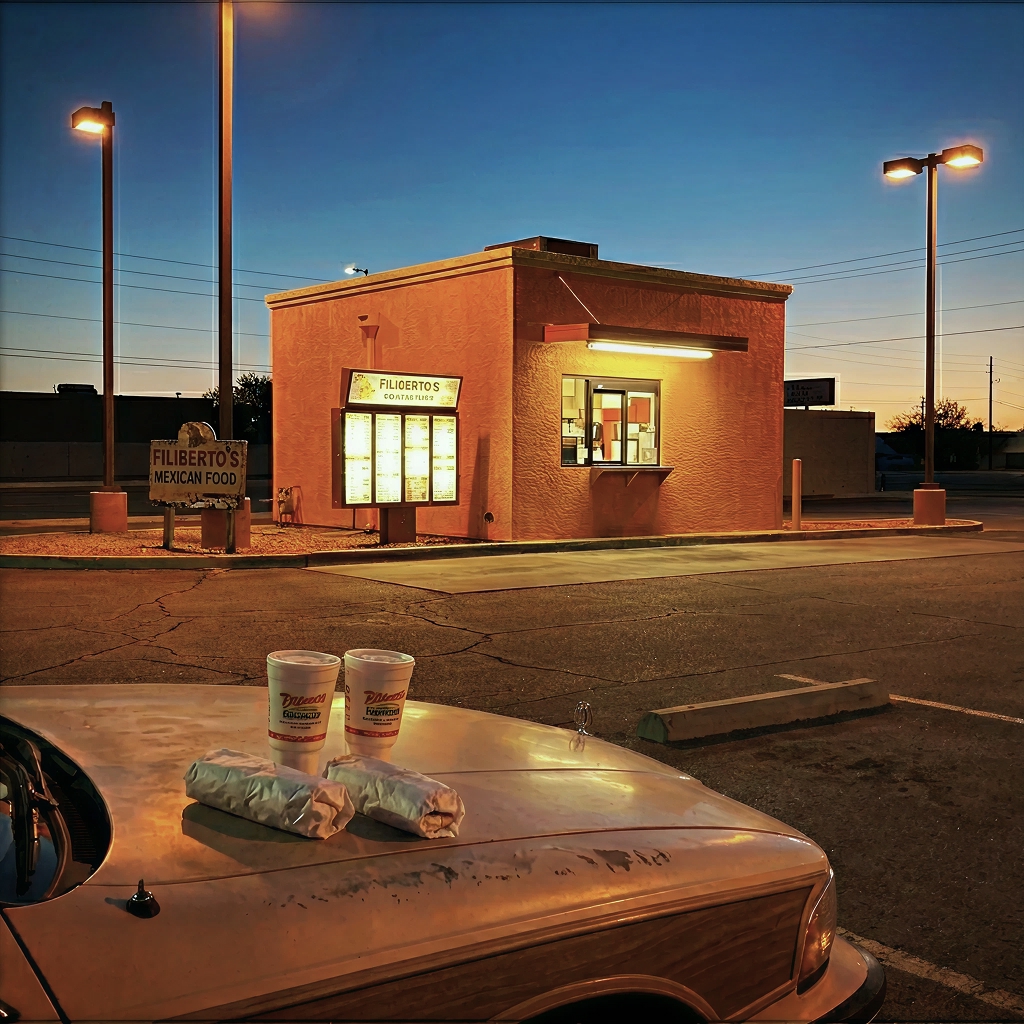
Tate picked dinner. This had not happened before. He pulled the Roadmaster into a Filiberto's drive-through on Scottsdale Road — an orange building, open twenty-four hours, no reservation required or conceivable. He ordered a carne asada burrito and a large horchata without consulting the menu. I ordered the same, because I had used up my decision-making capacity for the day. We ate in the parking lot. The burrito was excellent, despite my not having researched it.
We went to Chase Field the next night. No attempt to distribute bats until I formulated the protocol. A kid named Jose Fernandez, twenty-two years old, playing his first major league game, hit two home runs — a solo shot in the fourth and a three-run line drive in the eighth off Kenley Jansen that brought the Copper Works back from behind. It was the eighth time in MLB history someone had done that in their debut. Nearly thirty thousand in the seats on a Tuesday, and the ones who stayed past the seventh saw something they'd tell people about.
Back at the motel I sat down with a legal pad and wrote out everything Tate had asked, in the order he'd asked it. Who do we give them to. What caliber. What happens after. How to reorder. Who picks up the phone. I organized it into sections with headers and a decision tree. It filled two pages. I was pleased with it. In the morning Tate looked at it, borrowed my pen, and crossed out everything except three lines:
1. Starters and everyday guys only — no BP arms, no September roster. 2. One bat per player. They ask for more, they call the home office in Knockwood. 3. Get a name and a number before you leave.
I kept the legal pad anyway. We packed the Roadmaster on Thursday, after the Terminus came to town and beat the Copper Works 17-2, which is the kind of shellacking that makes you drive to Anaheim without looking back. The bats are in the car. The protocol is in my pocket. I don't know if Tate thinks it's enough. But I know he got in the car.
— Freely
Fantasy baseball without the homework.
Wallop is a home run-only game for friends — simple enough to play all season without the daily grind. Start a league and draft any time before September.
Start a League