The Good Seats
Bats distributed to date: zero. Equipment managers contacted: five, one of whom came out to find us in the parking lot, which has never happened before. Bats distributed: still zero.
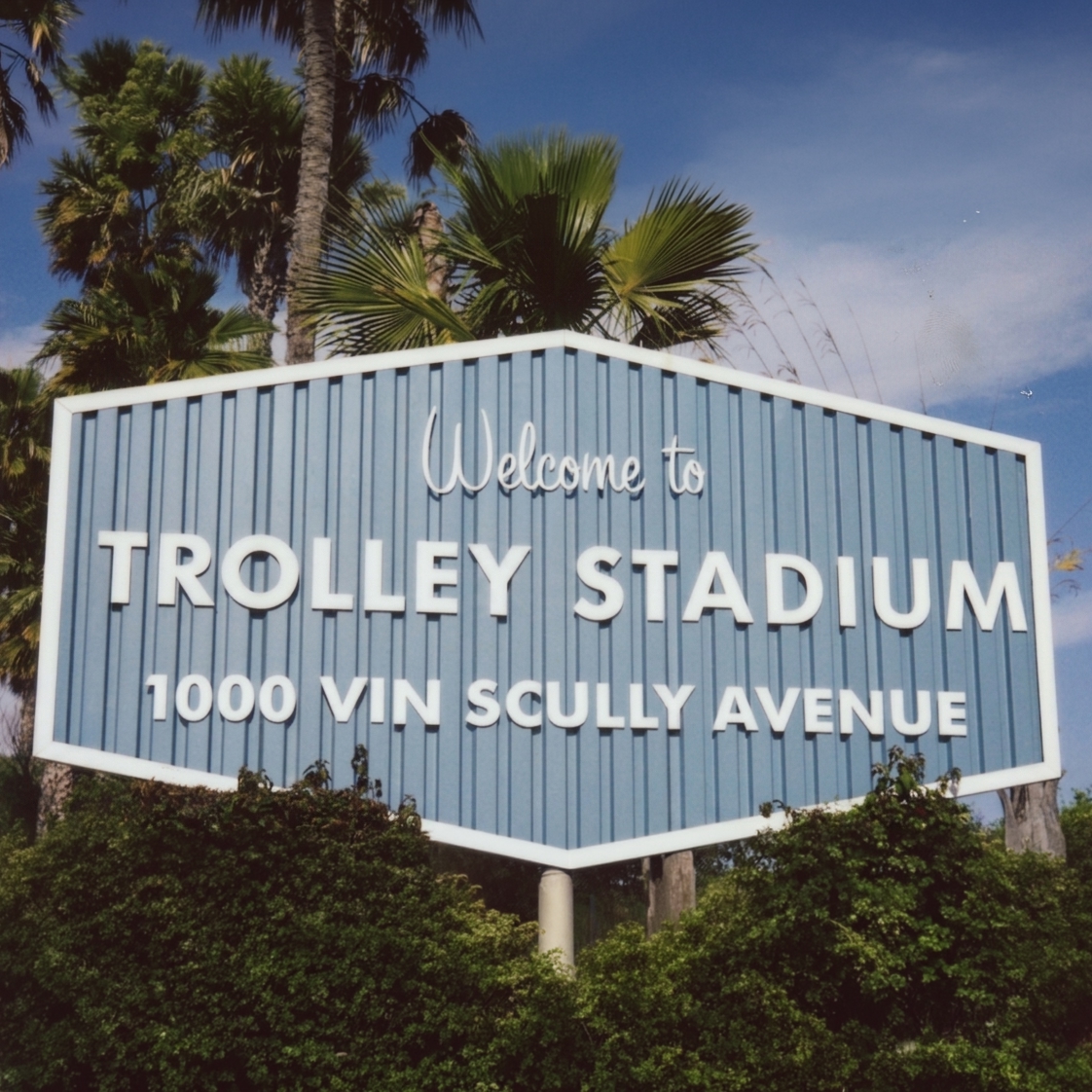
Tate was waiting for me at Chavez Ravine, home of the L.A. Trolley Problem.
I will not describe the reunion because there wasn't one. I had texted him Thursday with the details -- five o'clock, employee lot, ask for a man whose name I will withhold because he was kind to us and does not need email from strangers. Tate did not reply. He was standing at the will-call window when I pulled up Friday afternoon, same bag, same posture, as if the days between Anaheim and now had been a commercial break and he'd simply held his position through it. No acknowledgment of the text. No questions about the contact or how I'd gotten it. He was just there, on time, because the work was on.
Here is how we got in: my former colleague from the P-I, who landed at the LA Times after Seattle folded, now covers women's basketball -- specifically the Sparks. The Sparks and the Trolley Problem share an ownership group -- same people write the checks. One phone call from a women's basketball blogger to someone in that group, and we had a name in the equipment department at Chavez Ravine. The vital link in the chain was a beat I have never once thought about.
At five o'clock a man from the equipment office came out to the employee lot and asked if one of us was Freely. At every previous stop it has been Tate who gets us through the door -- a nod from a coach he played with, a name dropped to a clubhouse attendant, the kind of access you can only have if you spent forty years earning it. I have been the one holding the bat samples and trying to keep up. To have my name called in a parking lot -- mine, not his -- was so disorienting that I looked at Tate, and Tate looked at me, and for a half-second neither of us moved.
The man had a tan that looked medical-grade and a smile that did not leave his face for the duration of the conversation. He shook both our hands. He let us give our pitch. He held the bat. He turned it over in his hands the way you'd hope someone would turn it over. He asked about the volcanic soil and I told him -- the eruption, the mineral content, the new-growth Douglas fir -- and he listened, and nodded, and asked which volcano, because of course he was born well after Mount St. Helens went off. I thought: this is working. I looked at Tate and Tate's face was neutral in the way that meant he was letting me have the moment. Then the man handed the bat back and said, with an infinitesimal shrug and the same smile he'd been wearing, "We have a relationship with Louisville."
Delivered the way a cathedral tells you it already has stained glass.
"But it was great to meet you guys and I wish you all the luck in the world. These bats are really cool. Hey, let me comp you a couple of seats for the game."
The sunset over Trolley Stadium on a Friday evening in April is one of the finest things I have seen in professional sports. The San Gabriel Mountains go pink, then gold, then a color I might call amber. The air smells like grilled onions and dust and the particular warmth of fifty-six thousand seats absorbing a day of Southern California sun. The sightlines were perfect. The legroom was generous. I had a clear view of everything and I could not write a word of it.
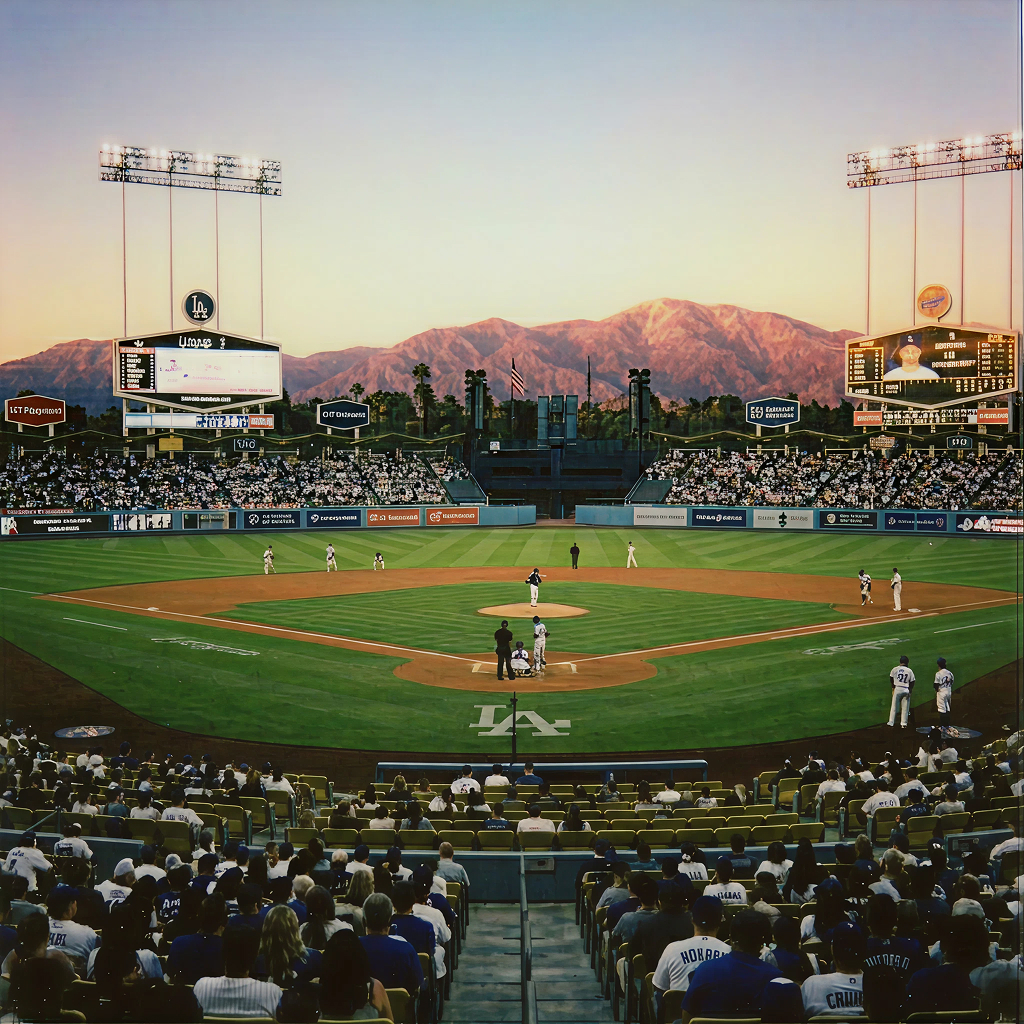
I have been writing from the bleachers for the last five dispatches. The bleachers are where I hear things -- the family explaining the infield fly rule (incorrectly), the vendor whose mustard technique has an opinion, the drunk who believes every fly ball is "outta here". From the good seats I could see the field but I couldn't find the story.
Most of what they say about LA fans appears true. At first pitch the seats around me were empty. They fill in around the third, maybe the fourth, until you're surrounded and can't remember the moment it happened. I had been alone in LA all week and now I was alone at a ballpark.
Max Muncy hit a home run in the second inning. I have Muncy on my Wallop roster -- Gary's fantasy league, the one I check at rest stops and refresh at red lights -- and when the ball cleared the wall I stood up in my good seat and clapped like a man whose evening had finally turned a corner.
Corey Seager played seven years for this franchise. Won a World Series here. When he stepped in for his first at-bat, the crowd gave him a standing ovation -- warm, genuine, the kind of outpouring you might not expect in Tinsel Town. In his second at-bat he hit a three-run homer 409 feet into the left field pavilion for the visiting Texas Drovers, and the ovation became a groan. Forty thousand people learning in real time that you can love someone and not want them to succeed.
Muncy hit another in the fourth. I stood up again. Two home runs from my guy on a night when I needed something to go right. From the good seats I was finally starting to feel something.
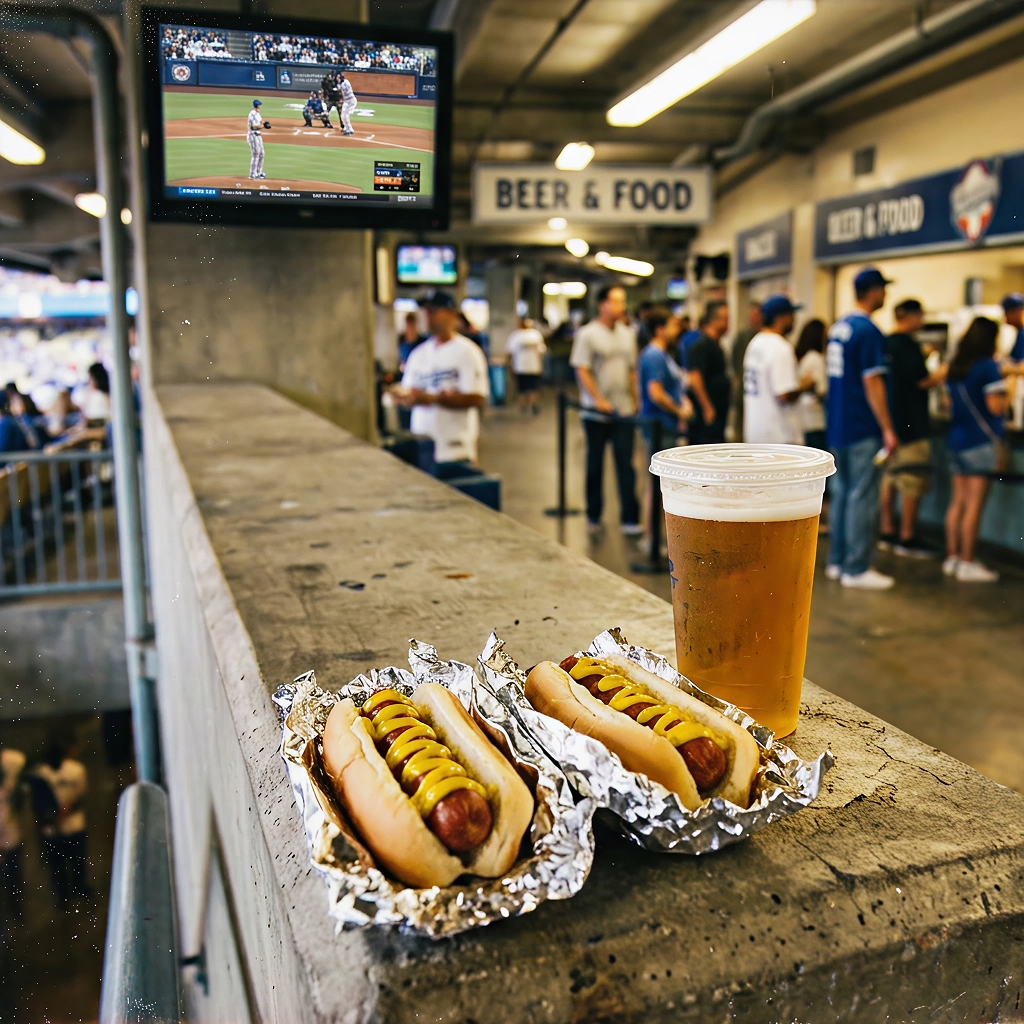
I got up after the fifth. I told myself I needed to move. I did not tell myself what I was moving away from. I walked the concourse for a couple of innings and ate two Trolley Dogs from a cart near the top deck -- $7.99 each, no research, no list, no recommendation from a food blog I'd bookmarked in a motel. The casing snapped. The mustard was the bright yellow institutional kind. The foil wrapper held. The menu also offered a sixteen-inch "Slugger" for $39.99, which I mention only because we had just been told they have a relationship problem with Louisville. I ate them standing up, leaning against a concrete pillar, watching the game on a monitor above a beer line.
I returned to the good seats in the eighth. Tate was talking to a tall Black man I half-recognized -- the posture of someone accustomed to being looked at, a deep voice that carried without effort. Crisp polo shirt and a hometown cap. He looked like the guy who played the president on the old '24' series.
They were talking about something I could not hear, and what I could see was Tate at ease. Not the professional ease of the equipment corridors -- something looser, unforced. The man said something and Tate laughed. I have been riding in a car with Tate for two weeks. I have heard him chuckle. I certainly have not heard him bust up like that. The thing I have been trying to do since San Diego -- sit next to Tate and have it feel easy -- a stranger managed in one inning.
I sat down. Timed my nod to the man poorly, so it went unnoticed. They talked for two more at-bats. The man then stood, shook Tate's hand, clapped the other on his shoulder and walked up the aisle.
In the bottom of the ninth, with the game knotted up, my hero Max Muncy hit his third — a walk-off home run, 401 feet, and the stadium shook in a way I could feel through the soles of my shoes. Three home runs. I had been celebrating all night. I pulled out my phone to check the standings and my score had not moved. I had benched him. I had benched him Tuesday from a motel desk in Hollywood, and every time I'd stood up and clapped I had been cheering for points that were not mine.
Tate, who drafted his Wallop roster and has not touched it since, did not look at my phone. He did not need to.
The Drovers are in town through Sunday, then Sacramento on Monday. I checked the schedule on my phone and suggested we follow them up the coast. Tate said nothing, which is how Tate says yes.
When we go, it'll be north on the 5 -- the same freeway I drove south on alone three weeks ago, forty-eight bats and an AM radio. Same road, opposite direction. The same number of bats will be in the back.
-- Freely
Fantasy baseball without the homework.
Wallop is a home run-only game for friends — simple enough to play all season without the daily grind. Start a league and draft any time before September.
Start a League