Two Teams
Bats distributed to date: zero. Pitches made on this stop: zero. Cage conversations conducted without a bat in hand: two. Names obtained, for later use: one.
We had left Childress with the hitchhikers at seven-thirty a.m. Hayden had not stopped talking since the motel parking lot — asking which Drovers he was supposed to want to see at batting practice, what Jung did, what Pederson did, whether Carter was any good — like he was coming with us, which he wasn't. Sochi slept against the window. We said our goodbyes and left them outside a Whataburger on Texas 121, where Hayden's mom was sending the stepdad to pick them up. The last thirty miles south to Arlington, we said nothing. Tate turned on the radio to a country station Hayden had left on. Neither of us changed it.
We checked into a Days Inn on Cooper — our own rooms again — and headed for the park.
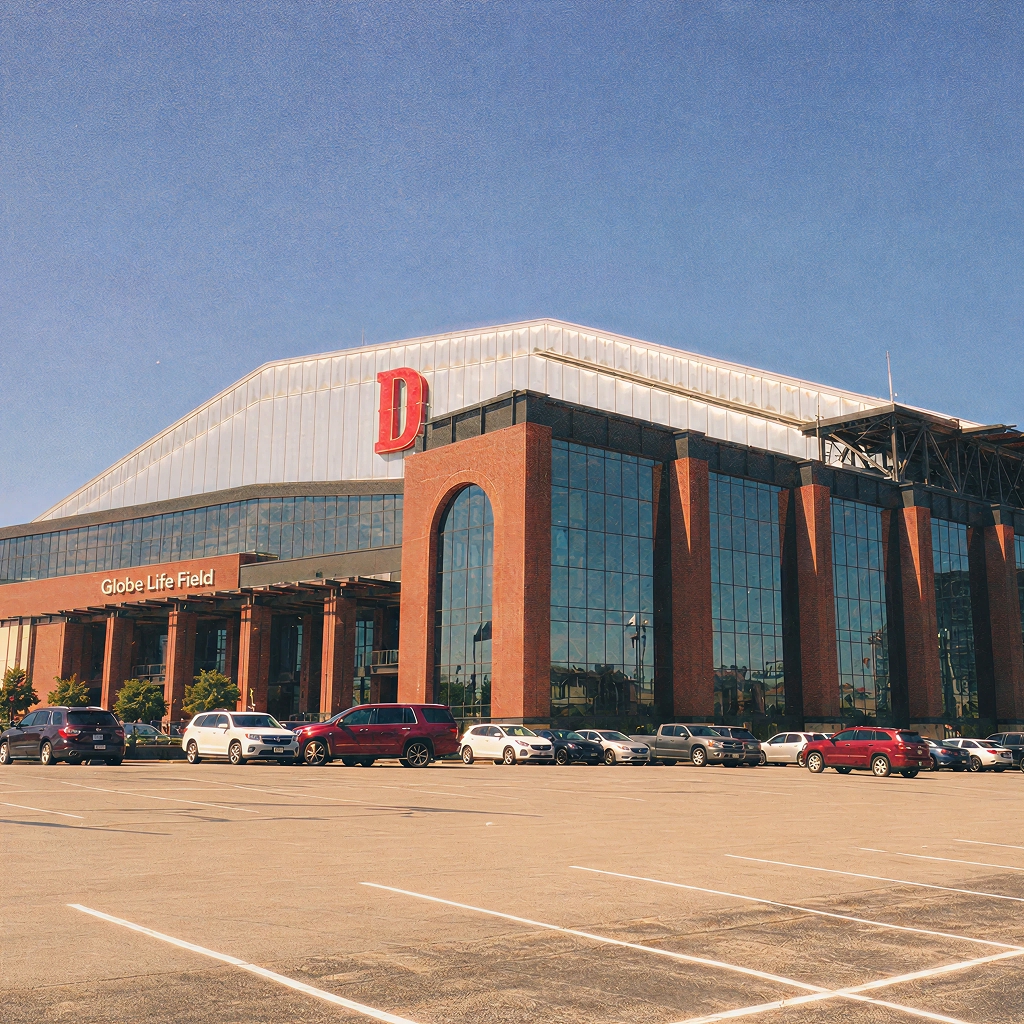
We arrived at Globe Life Field just after five. Eighty-six degrees on a bank sign across the road; the stadium roof was closed against it. The brick arches along the north façade looked like they were meant for a place that took itself seriously, which Globe Life does.
Walking toward the building, I asked Tate who the equipment manager was here.
"Don't know," he said. He looked at the building for a second. "They were in another park back then."
"Maybe we don't go through the equipment guy this time?" I said.
Tate stopped. He looked back at the wagon. "Yeah."
We returned to the wagon and left the bats. Then we made our way inside to a seventy-two-degree, state-of-the-art engineered environment.
Four days earlier, the Rockpile had made weather part of the game.
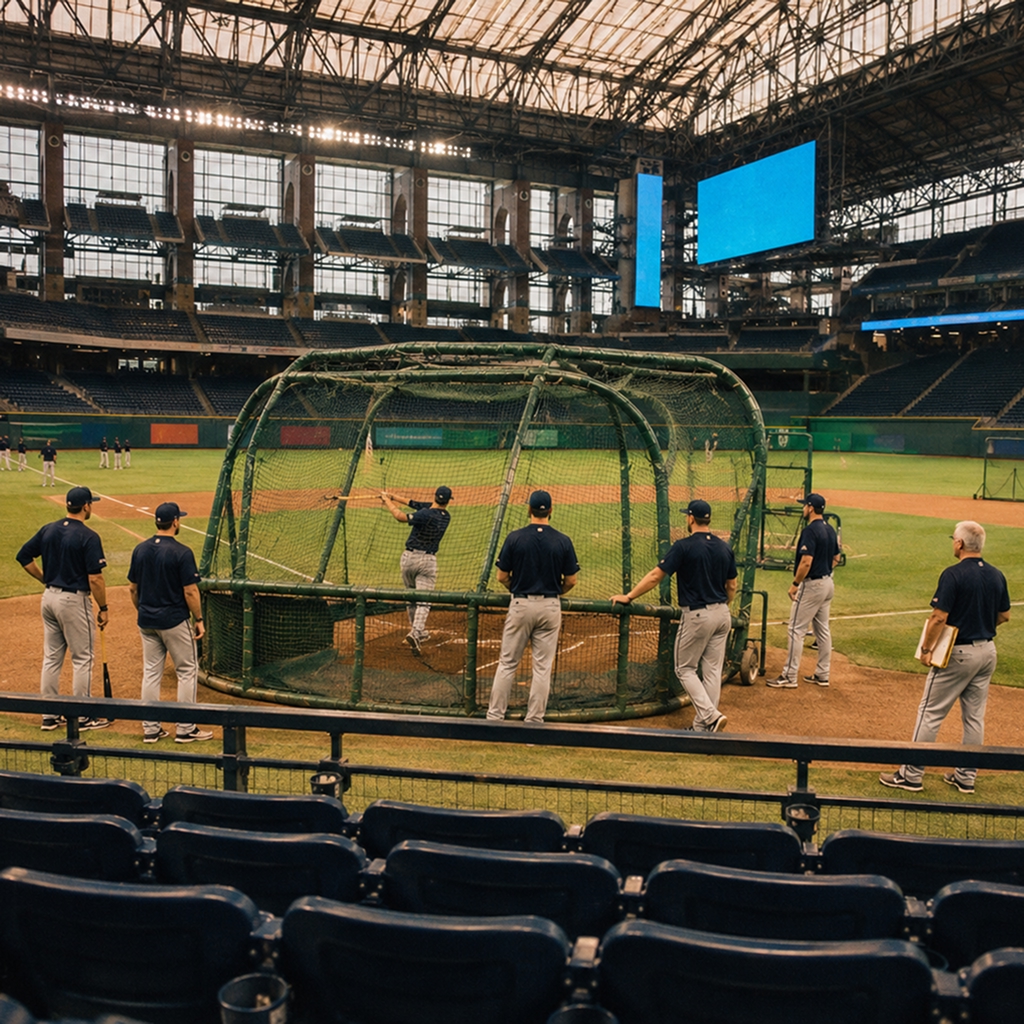
We were down in the lower bowl by five-thirty. The cage was up, batting practice well underway. The sound of horsehide on ash, a player on the back side of the cage yelling something I couldn't follow about a turn at second.
Tate looked at the cage and sized up the men standing around it.
"That one."
The man Tate had picked was approaching forty. Folder in his hand, a clipboard sleeve over the cover. Drovers polo, gray pants, the tooled belt of a man who had spent twenty years in uniform pants and was now in the next phase of that life. Tate walked up to the rail and gave his name. He looked at me.
The man followed the look. "You're with him?"
"Freely."
"I'm Brett. What can I do for you guys?"
"I wanted to ask you a question, if you have a few minutes. About bats — what your guys are swinging."
He glanced at the cage. "Couple minutes I got."
"What's the friction with bats this year? What are guys complaining about?"
He laughed once, no humor in it. "Where do you want me to start? I have three different pencil profiles in this cage. I have a guy who's tried five brands this season. He's hitting .238. Kid comes up from Triple-A swinging the model his Triple-A coach had him on, and now he's a pro and he wants it custom, and the manufacturer's three months out, so he swings what's in the rack and complains about it."
"Anybody on torpedoes?"
"Two of those, yeah. Thick part halfway down, thin at the end — looks like a bowling pin." He gestured a shape with one hand. "We're not built for it here. From what I've seen, Chicago across the way have got at least six different shapes this weekend."
He nodded across the diamond. The visiting Orphans were stretching in left.
"My job used to be hitting," he said. "Now it's about one-third bat-management."
He asked me what we did and I told him: small wood, Pacific Northwest, growing on volcanic soil. He'd heard this kind of thing before. He nodded. He did not ask the follow-up.
"All right," he said. He was already turning. "Send me a sample sometime if you want. I'll have a look. We're pretty much locked in this year, but there's always next year."
The cage guys called him over for the round.
We sat in cheap seats. By the bottom of the fifth it was four-zero.
A first baseman named Foscue I had not heard of came up to lead off the inning and hit one to left for what the announcer-board confirmed, with capital letters, was the first home run of his career. He ran the bases like a man trying to make sure his face stayed off the broadcast. The crowd, thinning out by that hour, gave him the kind of standing ovation that wanted to be louder if there had been more people in the seats. Drovers won six to nothing.
In the wagon we had agreed to leave at six in the morning — Houston was four and a half hours, get in early afternoon, find something Tate could approve of for dinner. It was a clean plan.
At his door Tate stopped, key in his hand, not putting it in the lock.
"You know, the other dugout's got bats too," he said.
He still hadn't moved.
"Chicago batting practice tomorrow?"
"Yeah," I said.
I went into my room and settled in.
Sunday morning I was propped on two limp pillows with a morning news show silent on the TV. I opened the long text I'd drafted the night before. Cut everything I would later regret.
Happy Mother's Day. How was Asher's visit to Reed?
I put the phone down. I made coffee in the small, plastic in-room coffee maker, which had a permanent ring of mineral deposit at the bottom of the carafe and a sticker on the side that read Daily Cleaning Assured. I drank a cup standing by the window. Watched Tate cross the parking lot alone.
We met at the wagon at ten.
We were at Globe Life by ten-thirty. The roof was closed against another mid-eighties day. Orphans batting practice was already going. Tate stood at the rail and watched for a few minutes before pointing.
"Him."
He had picked a man in his fifties in an Orphans polo, a measured-step pace between the cage and a folding chair, watching swings without a clipboard but with the alertness of a person who had a clipboard somewhere.
We walked over. Tate said Brett's name, pointed to the Texas dugout. The man knew it.
"Pete Henley," he said. "What've you got?"
I asked him the question from the day before: what's wrong with bats this year, what's missing.
My phone buzzed. A quick glance showed my ex's name on the screen. I put it away.
He went on for ten minutes. He had questions of his own. I gave him the short version: small wood, Pacific Northwest, volcanic soil, density we were still learning how to talk about. I expected him to nod and pivot. He didn't.
He said PNW wood was new to him. He asked about density profile. I hedged. Tate gave him the real answer. Pete's eyes stayed on Tate a second after Tate stopped talking. I had the next one.
He turned back to me. "Where are you guys headed?"
"Houston," I said. "Then Tampa."
"Stopping in Chicago at any point?"
"We should be at the Friendly Confines by August."
He nodded. Made a small sound in his throat.
He had to go. He looked at his watch.
"Bring some up when you come," he said. "Not a lot — three, four. I want to put them in a few hitters' hands and see what they tell me. We've got a homestand then."
Tate confirmed Pete's name and wrote it on the back of a parking stub when we got out of the cage area, working the pen in small block letters against his palm.
I took my phone out on the walk back to the seats. I read the message standing at the top of the section.
Thanks. They picked Grinnell.
I put the phone away. Sank into the seat.
Tate tapped my knee to stand back up for the national anthem.
The Mother's Day game was starting. The woman a few seats down our row had a pink ribbon pinned to a Michael Young jersey faded at the shoulders. Her teenage son leaned in to point something out on the field.
Grinnell, I thought. Iowa. Reed had been close and probably doable. Grinnell was a number I hadn't yet looked at.
We watched the game from the same section as the day before. The Drovers were wearing pink wristbands. A few of their hitters were swinging pink-handled bats, as was one of the Orphans. Tate watched with his usual focus.
In the first inning Jacob deGrom struck out Suzuki — on a slider, Tate confirmed – for his 1,900th career strikeout, and the announcer-board flashed the number. Suzuki walked back to the dugout without looking up. The thirty-seven-year-old on the mound nodded once at the catcher and went back to work.
Top of the second, the woman's husband worked his way back from the concession line, squeezing past us with a tray and a quick apology. He handed her her drink before his own.
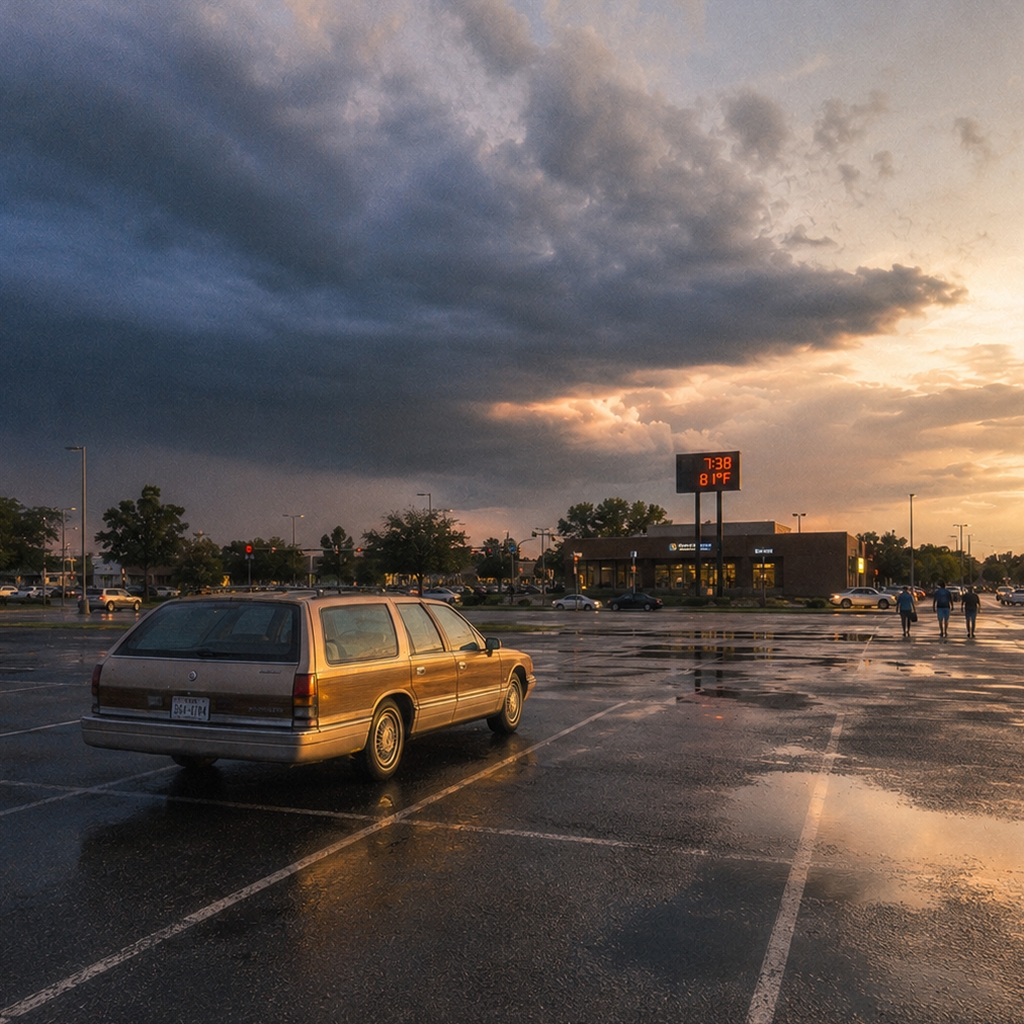
We left late, after the last out. By the time we exited to the natural world the lot had emptied to a few stragglers and the asphalt was wet from a shower we'd been oblivious to under the roof. The bank sign read seventy-five. A storm was building to the west. The Polaroid was on the dash where Hayden had left it, hand up, turned toward the window. I started the wagon. We drove out.
— Freely
Fantasy baseball without the homework.
Want in for the 2027 season? Leave your address and we’ll send one note when leagues open in March.